9 Best Outdoor Weather Stations for Wind and Rain (October 2026)
The best outdoor weather stations for wind and rain include the Tempest Weather Station for app-first monitoring, the Ambient Weather WS-5000 for a full color console, and the Ecowitt Wittboy Pro HP2564 for adding sensors later.
On this page (6 sections)
- Which outdoor weather station is best for wind and rain?
- Best outdoor weather station picks for different setups
- What should you compare in an outdoor weather station?
- Does an outdoor weather station need a display?
- Where should you mount a wind and rain station?
- Which outdoor weather station should you choose?
The best outdoor weather station for wind and rain is the Tempest Weather Station if you want an app-first system with no moving parts and frequent updates. For a console, the Ambient Weather WS-5000 includes an ultrasonic array and rain cup, while the Ecowitt Wittboy Pro HP2564 pairs a WS90 sensor with a display and supports additional sensors.
Wind and rain measurements depend on outdoor sensor placement and how you plan to read the data. For a broader starting point, see our backyard weather station guide and our best weather stations for home use.
Our picks at a glance
-
1

-
2
-
3
Which outdoor weather station is best for wind and rain?
The Tempest is the strongest match for app-first monitoring, while the WS-5000 is the most complete console package in this group. The other picks trade display style, sensor expansion and rain measurement approach.
We compared the stated wind and rainfall features, display options, power setup and data access. Our score weighs specs, features and buyer feedback against what you’re shopping for.
| Product | Best for | Wind sensor | Display | Outdoor power | Our score |
|---|---|---|---|---|---|
| Tempest Weather Station | app-first monitoring | Non-mechanical | App; no display | Solar powered | 9.0 |
| Ambient Weather WS-5000 | a full color console | Ultrasonic | TFT full color LCD | Solar powered | 8.5 |
| Ecowitt Wittboy Pro HP2564 | adding sensors later | Ultrasonic | 7-inch TFT | Solar or backup batteries | 8.4 |
| Ambient Weather WS-4000 | a compact all-in-one setup | Ultrasonic | LCD | Solar powered | 7.9 |
| Sainlogic Professional 7.5-Inch | a large, readable screen | Wireless sensor | 7.5-inch color display | Battery powered | 7.7 |
| Davis Vantage Vue | frequent wind updates | Ultrasonic | Console not included | Solar with backup battery | 7.6 |
| Ecowitt WS3901 Wi-Fi Kit | a Wi-Fi gateway console | Ultrasonic | 7.5-inch LCD | Solar or batteries | 7.6 |
| AcuRite Atlas | lightning detection | Anemometer | HD display | Not specified | 7.5 |
| La Crosse 328-1415 Cyclone | wind and rain alerts | Cyclone sensor | Color LCD | Sensor solar panel extends battery life | 7.2 |
Best outdoor weather station picks for different setups
These picks cover app-only monitoring, console-based reading, sensor expansion and simple wind and rain alerts. Match the station to how you will mount it and check its readings.
Tempest Weather Station: Best for app-first monitoring
- Wind speed and direction
- Rainfall, UV and lightning readings
- Solar-powered outdoor sensor
- App and Alexa enabled
The Tempest combines wind and rainfall readings with temperature, humidity, pressure, UV and lightning data in one outdoor sensor. Its app-first setup suits buyers who do not need a dedicated console.
Pros
- No moving parts
- Wireless transmission up to 1,000+ ft
- Real-time updates every 3 seconds
Cons
- No display included
- Requires a phone or compatible smart home setup for convenient viewing
Tempest combines wind speed and direction with rainfall, temperature, humidity, pressure, dew point, solar radiation, UV and lightning readings. The outdoor sensor is solar powered, sends data wirelessly, and updates every 3 seconds.
There is no display, so this pick works best if you are comfortable checking a phone or using a compatible smart home setup. It supports Alexa, Rachio, IFTTT and other smart home platforms.
The sensor has no moving parts, so it does not use wind cups or a moving rain gauge mechanism. WeatherFlow gives a wireless range of 1,000+ feet, though placement and obstacles can affect signal reach at your property.
Choose Tempest if you want one outdoor device and app access for several weather measurements. If you prefer a dedicated screen, compare it with the Ambient Weather WS-5000 review.
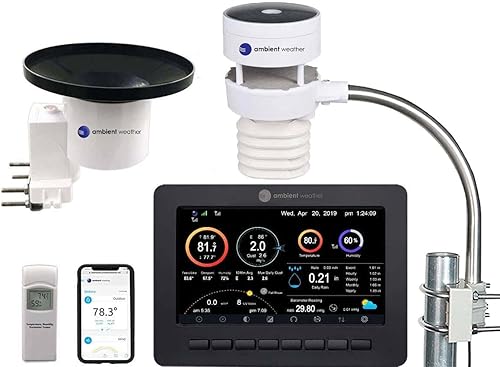
Ambient Weather WS-5000: Best for a full color console
- Ultrasonic sensor array
- Rain cup
- TFT full color LCD display
- Updates every five seconds
This package includes an ultrasonic array, rain cup, indoor sensor and full color display. It fits buyers who want wind and rain data at a console, with optional Wi-Fi connections.
Pros
- No moving parts in the ultrasonic array
- Console included
- Remote data and smart home features
Cons
- Requires 5 AA batteries
- Mounting pole is not included
The WS-5000 is a fit for buyers who want a console included with an ultrasonic wind array and rain cup. It also comes with an indoor sensor for temperature, humidity and pressure.
The array updates conditions every five seconds and has no moving parts. Ambient Weather gives a line-of-sight wireless range of up to 1,000 feet in open air, with a shorter range under most conditions.
Its color LCD console shows readings at home, while Wi-Fi can send data to the Ambient Weather Network and support remote access, alerts and smart home connections. The included array is solar powered, and the system requires 5 AA batteries.
Choose the WS-5000 if console viewing and its rain cup are priorities. Our WS-5000 vs WS-2000 comparison explains how the two Ambient Weather systems differ.
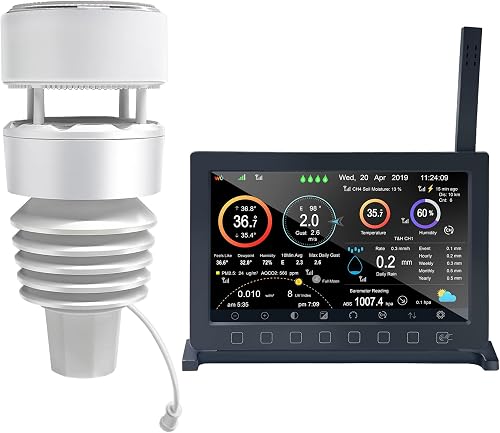
Ecowitt Wittboy Pro HP2564: Best for adding sensors later
- WS90 7-in-1 outdoor sensor
- Haptic rainfall sensor
- 7-inch TFT display
- Pairs with Ecowitt sensors
The Wittboy Pro pairs a WS90 sensor with a display console and can connect to additional Ecowitt sensors. Its haptic rain sensor suits general rainfall tracking, with Ecowitt noting that readings can vary with raindrop size and wind.
Pros
- Wind, rain, UV and light readings
- Console and app viewing
- Supports additional Ecowitt sensors
Cons
- Rain readings may vary in some conditions
- Outdoor backup batteries are not included
The Wittboy Pro pairs the WS90 outdoor sensor with a 7-inch TFT console. It measures wind speed and direction, temperature, humidity, light, UV and rainfall.
Its haptic rain sensor does not use a traditional tipping bucket. Ecowitt notes that raindrop size and wind speed can affect readings, so buyers who need precise totals for each rain event can pair the station with a separate WH40 rain gauge.
The console can connect with other Ecowitt sensors, including soil moisture and air quality sensors. After Wi-Fi setup, it can upload data to supported weather services and the Ecowitt server.
Choose this kit if you want a console now and room to add sensors later. For a closer look at the WS90 sensor setup, read our Ecowitt Wittboy GW2001 review.
Ambient Weather WS-4000: Best for a compact all-in-one setup

- Ultrasonic wind gauge
- Haptic rain gauge
- Color console included
- Remote monitoring and alerts
The WS-4000 combines ultrasonic wind and haptic rain gauges in a compact array, with a color console and indoor sensor. It suits buyers who want those sensor types without a separate rain cup.
Pros
- No moving parts in wind and rain gauges
- Color console included
- Ambient Weather Network support
Cons
- Wi-Fi is needed for remote monitoring
- Mounting pole details are not specified
The WS-4000 combines an ultrasonic wind gauge and haptic rain gauge in a compact outdoor array. A color console and indoor temperature, humidity and pressure sensor are included.
Both outdoor gauges have no moving parts, which can reduce mechanical upkeep compared with designs that use spinning cups or a tipping rain bucket. Ambient Weather connects the station to its network for remote monitoring, data analysis and alerts.
The solar-powered station works with Wi-Fi for remote features. Its compact array may suit a yard where a larger separate sensor layout is hard to place, though you still need a suitable mounting location for clear wind and rain exposure.
Choose the WS-4000 if you want an all-in-one sensor design with a console. Check the solar powered weather station guide if limiting routine battery changes is high on your list.
Sainlogic Professional 7.5-Inch: Best for a large, readable screen

- 7.5-inch color screen
- Wind speed and direction
- Rainfall totals across multiple timeframes
- Wireless sensor sync
Sainlogic pairs wind and rainfall measurements with a large indoor display. It tracks rainfall totals by hour, day, week, month and year.
Pros
- Large, high-contrast screen
- Adjustable backlighting
- Tracks hourly through yearly rainfall totals
Cons
- No Wi-Fi
- Uses 3 AA batteries
Sainlogic pairs a 7.5-inch color screen with an outdoor sensor that measures wind speed, wind direction and rainfall. The screen has large fonts and adjustable backlighting for clearer viewing.
The manufacturer gives rainfall accuracy as ±1 mm below 15 mm and ±7% for heavier rainfall. It tracks totals by hour, day, week, month and year.
This model has no Wi-Fi, so readings stay tied to the included wireless display. Sainlogic describes mounting the sensor on a sturdy surface such as a fence post or deck rail.
Choose it if screen size matters more than remote access. Confirm that its display and connection method fit your daily routine before selecting it.
Davis Vantage Vue: Best for frequent wind updates

- Wind updates every 2.5 seconds
- Rain measured in 0.01-inch increments
- Solar powered with battery backup
- Wireless transmission
The Vantage Vue sensor suite reports wind every 2.5 seconds and measures rain in 0.01-inch increments. The sensor suite is sold without a console, so plan how you will view or collect its data.
Pros
- Fast wind updates
- Rain collector measures in 0.01-inch increments
- Solar power with backup battery
Cons
- Console not included
- Mounting pole sold separately
The Davis Vantage Vue is a sensor suite for buyers who care about frequent wind updates and fine rain increments. It reports wind every 2.5 seconds and measures rain in 0.01-inch steps.
Its outdoor unit uses solar power, a supercapacitor for nighttime power and a backup lithium battery. Davis gives a transmission range of up to 1,000 feet line of sight, and the unit includes mounting hardware, though the pole is sold separately.
The key planning detail is that the console is not included. Decide how you will view and collect the data before buying the sensor suite.
Choose the Vantage Vue if those wind and rain measurement details suit your needs and you already have a compatible way to view readings. For a brand-specific comparison, see Davis weather station options for home use.
Ecowitt WS3901 Wi-Fi Kit: Best for a Wi-Fi gateway console

- WS90 7-in-1 outdoor sensor
- 7.5-inch LCD console
- Wi-Fi data viewing
- Pairs with additional sensors
The WS3901 combines a WS90 sensor with a 7.5-inch console that can send data to supported weather services. Its console also pairs with separate Ecowitt sensors and IoT devices.
Pros
- Console and outdoor array included
- View data through the app after Wi-Fi setup
- Supports additional sensors
Cons
- Other sensors are sold separately
- Outdoor batteries are not included
The WS3901 includes a WS90 outdoor sensor and a 7.5-inch LCD console with Wi-Fi support. The console can show sensor data and send it to Ecowitt and other supported weather services after setup.
Like the Wittboy Pro, its WS90 measures rainfall with a haptic sensor, and the console can pair with additional Ecowitt sensors. Those extra sensors are sold separately.
The outdoor sensor is solar powered or battery powered, with batteries not included. The console can also pair with compatible IoT devices such as a watering timer or smart outlet.
Choose the WS3901 if you want Wi-Fi data access through a larger console and may add sensors later. Compare the Ecowitt gateway options if you are deciding how to connect an Ecowitt setup.
AcuRite Atlas: Best for lightning detection

- Wind speed and direction
- Rainfall, UV and light readings
- Lightning detection
- Direct-to-Wi-Fi display
Atlas combines wind and rain monitoring with lightning detection and a Wi-Fi display. Choose it if storm information and a broad set of weather readings matter alongside outdoor measurements.
Pros
- Lightning detection up to 25 miles
- Wi-Fi connection to Weather Underground
- Display has battery backup
Cons
- Uses a corded display
- Outdoor power details are not specified
Atlas includes a Wi-Fi display and outdoor sensor for wind, rain, temperature, humidity, UV and light readings. It also adds lightning detection up to 25 miles, plus a built-in barometer.
The display can connect to Weather Underground and has optional battery backup to save monitor data and settings during an outage. The outdoor sensor attaches with the included mounting bracket and hardware.
AcuRite describes its forecasting approach as combining elevation and atmospheric pressure to create a personalized 12-hour forecast. The station also offers more than 20 data points, so it can suit buyers who want more than just wind and rain measurements.
Choose Atlas if lightning detection and a Wi-Fi display are useful alongside its outdoor readings. Our AcuRite Atlas vs Iris comparison covers another AcuRite option.
La Crosse 328-1415 Cyclone: Best for wind and rain alerts

- Wind speed up to 111 mph
- Rainfall history
- Customizable alerts
- 330-foot wireless range
The Cyclone station tracks wind history and rainfall across several timeframes, with customizable alerts for changing conditions. Its color display shows wind direction as a compass rose or in degrees.
Pros
- Wind records from 1 hour to 1 year
- Rainfall history from the past hour to last year
- Custom wind and rain alerts
Cons
- Outdoor sensor uses batteries
- Wireless range is stated as up to 330 ft
The La Crosse 328-1415 combines a color display with wind speed and direction, rainfall totals, and indoor and outdoor temperature and humidity. Its Cyclone sensor reports wind speeds up to 111 mph, and wind direction appears as a compass rose or degrees.
The display supports custom alerts for wind speed and rainfall, along with temperature and humidity changes. It also records wind history from the past hour through the year and rainfall from the past hour through the past year.
The outdoor sensor has a solar panel to extend battery life, while the base uses an AC adapter with battery backup. La Crosse gives a wireless range of up to 330 feet.
Choose this model if you want a console, rainfall history and alerts without Wi-Fi. The 330-foot wireless range may matter on larger properties.
What should you compare in an outdoor weather station?
Compare the wind sensor, rain gauge, display and data access before choosing an outdoor weather station. Those details determine how you will read the data and what upkeep the outdoor unit may need.
An ultrasonic wind sensor has no cups to spin, while a mechanical anemometer uses moving parts. Rain measurement also varies: a tipping bucket counts collected rain, while a haptic sensor detects impacts and readings may vary with raindrop size and wind.
For more detail on the tradeoff, see ultrasonic vs mechanical anemometers. If rainfall totals are your priority, our tipping bucket rain gauge guide explains how that design measures precipitation.
Does an outdoor weather station need a display?
No, an outdoor weather station can work without a dedicated display if you are happy checking its app or online dashboard. A console is useful when you want readings visible at home without opening a phone.
Tempest is the app-first choice here, while the WS-5000, Wittboy Pro, WS-4000, Sainlogic, WS3901, Atlas and La Crosse include a display. The Davis Vantage Vue sensor suite does not include one.
Before buying, think about who needs to check readings and where they will do it. A large display may be easier to read in a shared room, while remote access helps when you are away from home.
Where should you mount a wind and rain station?
Mount the outdoor sensor where it has a clear exposure to wind and rain, following the station's instructions. Nearby roofs, walls, trees and fences can affect what the sensor receives.
A sturdy pole or other suitable mount helps keep the array stable. Compare the mounting method and available space before choosing an all-in-one sensor or a separate sensor suite.
Our guide to roof mounts and tripods for weather stations covers placement choices. For general setup priorities, see the backyard weather station guide.
Which outdoor weather station should you choose?
Choose the Tempest if you want app access, frequent updates and a sensor with no moving parts. Pick the WS-5000 if you want a full color console with an ultrasonic array and rain cup, or the Ecowitt Wittboy Pro HP2564 if you want a console with room to add sensors.
For a broader comparison across home setups, start with our best weather stations for home use.
Our top 3 picks at a glance
-
1
-
2
-
3


