Ambient Weather WS-5000 Review: Worth It? (October 2026)
The Ambient Weather WS-5000 suits you if you want an ultrasonic wind sensor, a rain cup and a full color console in one home station. It also offers optional remote data access and smart home connections.
On this page (9 sections)
- What does the Ambient Weather WS-5000 include?
- Who should buy the WS-5000, and who should skip it?
- Is the WS-5000's ultrasonic wind sensor a good fit?
- How do the console and remote features work?
- Where should you mount the WS-5000 array?
- How do you set up and care for the WS-5000?
- How does the WS-5000 compare with other Ambient Weather stations?
- Should you choose the WS-5000 or an app-only station?
- How should you decide whether to buy the Ambient Weather WS-5000?
The Ambient Weather WS-5000 is a home weather station with an ultrasonic sensor array, a rain cup, an indoor sensor and a full color console. If you're comparing the Ambient Weather WS-5000 for a backyard or garden, the main decision is whether its dedicated display and sensor setup match how you want to check local conditions.
The array sends updates every five seconds and uses ultrasonic wind measurement. You also need a suitable place to mount the array and a console location where the radio signal can reach it.
What does the Ambient Weather WS-5000 include?
The WS-5000 includes an outdoor sensor array, rain cup, indoor sensor and TFT full color LCD console. The indoor sensor measures temperature, humidity and barometric pressure.
Ambient Weather WS-5000: Best for backyard monitoring
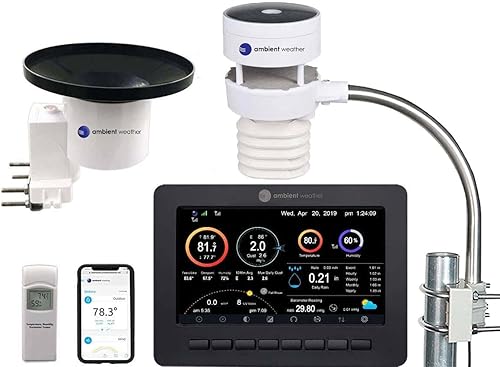
- Ultrasonic sensor array
- Rain cup
- TFT full color LCD display
- Indoor and outdoor temperature, humidity and barometric pressure
A home weather station with a no-moving-parts ultrasonic wind array, rain cup and color console. Remote access, alerts and smart home links add options if you want to use local weather data beyond the console.
Pros
- No moving parts in the wind sensor array
- Real-time weather updates every five seconds
- Includes a full color console and indoor sensor
- Optional Wi-Fi sharing and smart home features
Cons
- Requires a suitable pole, which isn't included
- Wireless range drops under most conditions
- The console may be more than you need if you mainly check an app
The outdoor array measures wind speed and direction, temperature, humidity, rainfall, UV and solar radiation. The console gives you a fixed place at home to read those conditions, while optional network features let you access data remotely.
That arrangement works well when you want to glance at a display without opening an app. It may feel excessive if everyone in the household checks weather only on a phone.
Who should buy the WS-5000, and who should skip it?
Buy the WS-5000 if you want an ultrasonic wind sensor, a rain cup and a console in one system. Skip it if you don't have a workable pole location or have no use for a dedicated display.
The sensor array's wind measurement has no moving parts, which may appeal if you want to avoid rotating wind cups. The included rain cup uses a different mechanism, so account for both sensor types when thinking about outdoor care.
The station is a better fit for a homeowner who plans to look at several local measurements, such as wind, rain and solar conditions, than for someone who wants a basic indoor forecast. Its remote and smart home options are useful only if you'll configure and use those connections.
Is the WS-5000's ultrasonic wind sensor a good fit?
The WS-5000 suits buyers who want wind readings from an array without moving wind cups. Its ultrasonic design measures wind speed and direction, while stations with mechanical anemometers use moving cups.
Fewer moving parts in the wind sensor means there are no wind cups to rotate, but it doesn't remove the need for a stable mounting point. Sensor placement still affects how representative the readings are, especially if the array sits close to walls, trees or roof edges.
Compare sensor design with your priorities in our guide to ultrasonic versus mechanical weather station anemometers. The WS-5000 also includes a rain cup, so the ultrasonic description applies to wind measurement rather than the whole system.
If rain measurement is a key reason you're buying a station, our guide to the tipping bucket rain gauge explains the basic collection method and why the gauge's position matters.
How do the console and remote features work?
The WS-5000 gives you readings on a local color console, with optional remote access through Ambient Weather Network. The outdoor array sends its readings to the console over radio frequency, so local readings do not depend on Wi-Fi.
Enhanced Wi-Fi lets you transmit station data to the personal weather station network if you enable that option. Ambient Weather Network supports a customizable dashboard and sharing hyperlocal conditions.
Smart home connections can add a practical use for the data. Ambient Weather describes alerts and home programming based on weather conditions using services that include IFTTT, Google Home and Alexa.
If you'll mainly use a phone and don't want a console on a counter or desk, consider an app-first setup instead. Our Tempest versus Ambient Weather comparison covers the difference between a display-led station and a station with no display.
Where should you mount the WS-5000 array?
Mount the WS-5000 array on a stable pole between 1.25 and 2 inches in diameter. Its adaptive bracket and U-bolt fit that range, and the pole must be supplied separately.
The array connects to the console over 915 MHz radio frequency. Ambient Weather gives a range of up to 1,000 feet in open air with line of sight, or 300 feet under most conditions.
The signal won't pass through solid metal, earth or ground. Choose a location with a clear path to the console when possible, and keep walls and other obstacles in mind when planning where both parts will sit.
The array includes a bubble level to help you check that it is plumb, along with a solar panel. Our weather station roof mount and tripod guide can help you think through placement before you choose a mounting point.
How do you set up and care for the WS-5000?
Set up the WS-5000 by choosing the array's location and console location before tightening the mount. This order helps you consider both sensor exposure and the radio path instead of discovering a weak connection after installation.
Use a pole that fits the bracket and check that the array is level with its built-in bubble level. Place the console where you can read it easily and where the signal has a reasonable path from outdoors.
The solar panel is part of the outdoor array, but the system also specifies 5 AA batteries. Check the manual for the correct battery role and installation steps, and keep the manual accessible for later maintenance.
For care, inspect the rain cup and surrounding area after storms or seasonal debris. Leaves, dirt or other obstructions can interfere with rain collection, so keep the gauge opening clear and avoid moving the array without checking its alignment afterward.
A common setup mistake is mounting the array where the signal must pass through metal or a large number of obstacles. Another is choosing a pole before checking its diameter, which can leave you with a mounting point the bracket cannot secure.
How does the WS-5000 compare with other Ambient Weather stations?
The WS-5000 stands out for its ultrasonic wind array, rain cup and dedicated color console. The WS-2000 also has a color display and broad measurements, while the WS-4000 pairs ultrasonic wind measurement with a haptic rain gauge.
Ambient Weather WS-2000: Best for flexible displays

- TFT color display
- Wind, temperature, humidity, rainfall, UV and solar radiation
- Imperial and metric units
- Calibration available
A color-console Ambient Weather station with an integrated array for wind, temperature, humidity, rainfall, UV and solar radiation. Consider it if you want a console and prefer its sensor arrangement to the WS-5000's.
Pros
- Measures several common outdoor conditions
- Supports imperial and metric units
- Calibration is available
- Optional Wi-Fi weather publishing
Cons
- Uses an array with moving wind cups
- Indoor sensor is optional
- Sensor array needs 3 AAA backup batteries
The WS-2000 measures wind speed and direction, temperature, humidity, rainfall, UV and solar radiation. It supports imperial and metric units and allows calibration, but its sensor array differs from the WS-5000's ultrasonic design.
Ambient Weather WS-4000: Best for compact installations

- Ultrasonic wind gauge
- Haptic rain gauge
- Color console
- WH32B indoor sensor
A compact Ambient Weather option with ultrasonic wind measurement and a haptic rain gauge, both designed without moving parts. It includes a color console and indoor sensor.
Pros
- No moving parts in wind and rain gauges
- Includes a color console
- Includes an indoor temperature, humidity and pressure sensor
- Supports remote monitoring through Ambient Weather Network
Cons
- Uses a haptic rain gauge instead of a rain cup
- Has fewer stated setup details than the WS-5000
- Its fit depends on whether you want the WS-5000's sensor arrangement
The WS-4000 also has no moving parts in its ultrasonic wind and haptic rain gauges. It includes a color console and an indoor sensor, which makes it another option if you want those sensor types in a compact setup.
For a closer feature-by-feature comparison, read Ambient Weather WS-5000 vs WS-2000. Our Ambient Weather station guide covers the brand's broader range.
Should you choose the WS-5000 or an app-only station?
Choose the WS-5000 if you want a dedicated indoor console alongside outdoor measurements. Choose an app-first station if you'll use a phone for readings and don't need a display at home.
Tempest Weather Station: Best for phone-first homes

- No display
- Solar-powered outdoor sensor
- Temperature, humidity, pressure, wind, rain, UV and lightning data
- Alexa and IFTTT support
Tempest is an app-first station with no display, a solar-powered outdoor sensor and a broad set of measurements. Consider it when you prefer phone access and smart home links over a dedicated console.
Pros
- Measures wind, rain, temperature, humidity, pressure, UV and lightning
- No moving parts
- Solar-powered outdoor sensor
- Alexa and IFTTT integration
Cons
- No display is included
- Its app-centered setup differs from the WS-5000 console approach
- Installation options aren't described
Tempest has no display and uses a solar-powered outdoor sensor. Its stated measurements include temperature, humidity, barometric pressure, wind, dew point, solar radiation, UV, lightning and rainfall, with Alexa and IFTTT support.
The WS-5000 is the more natural fit if you want household members to check conditions at a glance on a console. Tempest is the clearer choice when a no-display setup better matches your habits.
How should you decide whether to buy the Ambient Weather WS-5000?
Choose the Ambient Weather WS-5000 if you want an ultrasonic wind sensor, a rain cup, a local color console and optional network features in one system. Choose the WS-2000 if its different array and console better match your priorities, the WS-4000 if you want its ultrasonic and haptic gauge combination, or Tempest if you prefer phone-first monitoring without a display.
Before you decide, confirm that you have a pole in the right diameter range and a reasonable radio path to the console. If both fit your home, the WS-5000 is a strong match for backyard monitoring that benefits from a dedicated screen and several outdoor readings.
Frequently asked questions
What does the Ambient Weather WS-5000 measure?
The WS-5000 measures outdoor wind, rainfall, temperature, humidity, UV and solar radiation through its sensor array. The included indoor sensor measures temperature, humidity and barometric pressure, while the color console displays station information.
Does the WS-5000 use an ultrasonic wind sensor?
Yes. The WS-5000's all-in-one sensor array uses ultrasonic technology and has no moving parts for wind measurement.
It also includes a rain cup, so the no-moving-parts feature does not apply to every part of the station.
Compare sensor types in our ultrasonic versus mechanical anemometer guide.
Does the Ambient Weather WS-5000 need Wi-Fi?
No, local readings reach the console over radio frequency. Enhanced Wi-Fi is an optional setting for sending data to the Ambient Weather Network, and smart home features can use services such as Google Home and Alexa.
What should you check before mounting the WS-5000?
Plan for a pole between 1.25 and 2 inches in diameter because the mounting bracket is designed for that range, and the pole is not included. Also check the radio path to the console: the stated range is up to 1,000 feet in open air with line of sight and about 300 feet under most conditions.


