9 Best Weather Stations to Buy for Your Home (October 2026)
The best home weather stations include the Ambient Weather WS-2902 for a connected home display, the Tempest Weather Station for app-first monitoring, and the Ambient Weather WS-2000 for a detailed color console.
On this page (4 sections)
The Ambient Weather WS-2902 is the best weather station for most homes because it combines a color console, a broad set of outdoor readings, Wi-Fi monitoring, and smart home features. For a simpler console, consider La Crosse; for an app-first system without a display, look at Tempest.
A home weather station choice depends on the readings you want and where you want to see them. A console makes readings visible indoors, while Wi-Fi and app features let you check conditions away from home.
For help with placement, sensors, and display choices, start with our backyard weather station guide. If you want Wi-Fi features, compare the picks in our smart weather station guide.
Our picks at a glance
-
1

-
2

-
3

Which weather stations stand out for home use?
The Ambient Weather WS-2902 is the best all-around fit here, while the other picks suit needs such as an app-first setup, sensor expansion, or indoor air readings. We compared their measurements, display options, connectivity, and sensor features.
Our score weighs specs, features, and buyer feedback against what home weather station shoppers are likely to need. It reflects an editorial comparison, not test results.
| Product | Best for | Display | Connectivity | Outdoor readings | Our score |
|---|---|---|---|---|---|
| Ambient Weather WS-2902 | a connected home display | Color LCD console | Wi-Fi, Google Home, Alexa, IFTTT | Wind, temperature, humidity, rainfall, UV, solar radiation | 9.1 |
| Tempest Weather Station | app-first monitoring | No display | Wireless, app and Alexa enabled | Wind, rain, temperature, humidity, pressure, UV, solar radiation, lightning | 9.0 |
| Ambient Weather WS-2000 | a detailed color console | TFT color | Wi-Fi option, 915 MHz sensor link | Wind, temperature, humidity, rainfall, UV, solar radiation | 8.8 |
| AcuRite Iris 01512 | a large color screen | Color LCD | 433 MHz wireless | Temperature, humidity, wind, rainfall | 8.4 |
| Ecowitt Wittboy Pro HP2564 | sensor expansion | 7-inch TFT | Wi-Fi, 915 MHz | Temperature, humidity, wind, rain, UV, light | 8.4 |
| La Crosse C85845 | indoor temperature and humidity | Color LED | Wireless | Temperature and humidity | 8.3 |
| Sainlogic 6.5-Inch 12-in-1 | a large wireless display | 6.5-inch HD color | Wireless; no Wi-Fi required | Temperature, humidity, wind, rainfall | 8.1 |
| AcuRite Atlas | lightning readings | HD | Wi-Fi | Temperature, humidity, wind, UV, light, rainfall, lightning | 7.5 |
| Netatmo Smart Weather Station | indoor air monitoring | App-based graphical display | 2.4 GHz Wi-Fi | 7.5 |
Best weather stations for different home needs
The best weather station for your home depends on whether you want an outdoor sensor array, a console, or app access. These picks are ordered by score, with each matched to a different use.
Ambient Weather WS-2902: Best for a connected home display
- Color LCD console
- Measures wind, temperature, humidity, rain, UV, and solar radiation
- Wi-Fi monitoring and alerts
- Google Home and Alexa support
A broad set of outdoor readings, a console, and Wi-Fi features make this a balanced pick for home monitoring.
Pros
- Console included
- Wind and rain measurements
- Remote access and alerts
Cons
- Sensor array needs a suitable mounting pole
- Console and sensor use different power arrangements
The WS-2902 fits if you want a console and connected features in one setup. Its sensor array measures wind speed and direction, temperature, humidity, rainfall, UV, and solar radiation, while the color LCD gives you an indoor view.
Wi-Fi provides remote access and alerts, and the station can connect with Google Home, Alexa, and IFTTT. You can also choose to share data with the Ambient Weather Network.
The outdoor array uses solar power with optional battery backup. It mounts to a pole between 1.25 and 2 in, so plan the mounting location before you buy.
Choose this if you want a screen at home plus remote monitoring. If solar power is a priority, see our solar-powered weather station guide.
Tempest Weather Station: Best for app-first monitoring
- No display
- Measures wind, rain, temperature, humidity, pressure, UV, solar radiation, and lightning
- Solar-powered outdoor sensor
- Alexa and IFTTT support
Tempest suits a home where phone access is enough and a dedicated indoor console isn't needed.
Pros
- No moving parts
- Solar-powered outdoor sensor
- Lightning readings
Cons
- No display included
- No console for a quick glance indoors
Tempest is the app-first choice if you don't need an indoor console. Its outdoor unit measures temperature, humidity, pressure, wind, dew point, solar radiation, UV, lightning, and rainfall.
The solar-powered sensor sends data wirelessly, and the system works with Alexa, Rachio, IFTTT, and popular smart home platforms. It has no moving parts, which may appeal if you want fewer mechanical components.
Without a display, you rely on the app for readings inside the home. Pick Tempest if remote access and smart home connections matter more than a dedicated console.
For outdoor placement and wind and rain priorities, our outdoor weather station guide covers the main setup decisions.
Ambient Weather WS-2000: Best for a detailed color console
- TFT color display
- Measures wind, temperature, humidity, rain, UV, and solar radiation
- Wi-Fi network sharing option
- Imperial and metric units
The WS-2000 combines a color console with a sensor array and optional internet weather sharing.
Pros
- Color console included
- Calibration available
- Imperial and metric units
Cons
- Console needs its power adapter
- Optional indoor sensor is separate
The WS-2000 suits you if you want a color console with outdoor readings and optional internet sharing. Its TFT display presents data from the integrated array, including wind, temperature, humidity, rainfall, UV, and solar radiation.
The console supports imperial and metric units, alarms, and calibration for major parameters. Wi-Fi sharing is optional, so consider whether you'll use online publishing.
The sensor array uses solar power with optional battery backup. The console uses the included 5V adapter, so it needs a spot near power.
Choose it if the console is central to your daily checks. If you want to compare Ambient's models, read our WS-5000 vs WS-2000 comparison.
AcuRite Iris 01512: Best for a large color screen

- Large color LCD with adjustable dimmer
- Measures indoor and outdoor temperature, humidity, wind, pressure, and rain
- 12-hour personalized forecast
- Historical data and over 55 data points
Iris pairs a large indoor display with outdoor readings and a forecast based on elevation and barometric pressure.
Pros
- Large color display
- Adjustable dimmer
- Included outdoor sensor
Cons
- Uses 10 AA batteries
- No Wi-Fi feature specified
AcuRite Iris fits homes where a large indoor screen matters. Its color LCD shows indoor and outdoor temperature and humidity, wind speed and direction, pressure, and rainfall, with a dimmer for adjusting screen brightness.
It also provides historical data and a forecast based on elevation and pressure readings. The outdoor sensor mounts to a pole or post with the included bracket, and the display shows time and date.
Iris uses radio-frequency wireless communication, and no Wi-Fi connection is specified. Pick it if you want local readings and a large screen without requiring app access.
Ecowitt Wittboy Pro HP2564: Best for sensor expansion
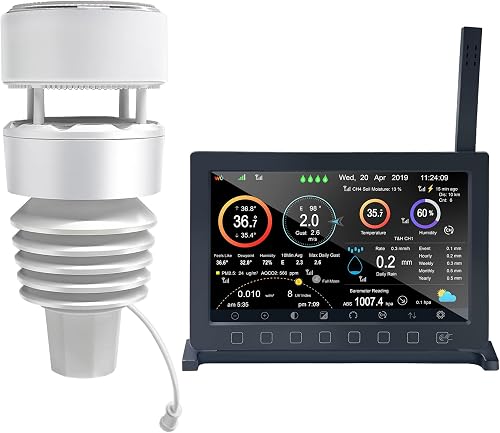
- 7-inch TFT console
- WS90 7-in-1 sensor
- Pairs with additional Ecowitt sensors
- Uploads data to supported weather services
The Wittboy Pro offers a console and a broad sensor pairing range for buyers who may add room, soil, pool, or air quality readings.
Pros
- Pairs with multiple Ecowitt sensor types
- Uploads to several weather services
- Solar-powered outdoor sensor
Cons
- WS90 rain readings can vary with conditions
- An optional rain gauge is suggested for precise rain data
The Ecowitt Wittboy Pro fits if you may expand beyond the included outdoor sensor. Its HP2560 console can pair with several Ecowitt sensor types, including soil moisture, thermometers, pool, air quality, and leak sensors.
The included WS90 array measures temperature, humidity, wind, light, UV, and rainfall. It uses a haptic rain sensor, and Ecowitt notes that rain readings can vary with raindrop size and wind speed.
It suggests pairing a separate rain gauge when precise rain totals matter.
The console can upload data to Ecowitt and several weather services after Wi-Fi setup. Choose this system if sensor expansion matters to you.
La Crosse C85845: Best for indoor temperature and humidity

- Color forecast display with trend arrows
- Indoor and wireless outdoor temperature and humidity
- Custom high and low alerts
- Dew point and heat index
La Crosse focuses on temperature and humidity with a clock, forecast display, and indoor comfort charts.
Pros
- Adjustable brightness
- Custom temperature and humidity alerts
- Self-setting clock
Cons
- No wind or rainfall readings specified
- Outdoor sensor needs 2 AA batteries
La Crosse is a straightforward choice for indoor and outdoor temperature and humidity, with a color forecast display and a self-setting clock. Its comfort charts show indoor and outdoor humidity, and you can set high and low alerts for temperature and humidity.
This station does not list wind or rainfall measurements, so it won't replace a full outdoor sensor array if those readings are essential. The display uses an AC adapter for constant backlighting, with optional battery backup for power loss.
Choose La Crosse for quick indoor checks and outdoor temperature and humidity. For a station focused on yard wind and rain, compare the options in our outdoor weather station guide.
Sainlogic 6.5-Inch 12-in-1: Best for a large wireless display

- 6.5-inch HD color display
- Tracks temperature, humidity, pressure, wind, rain, dew point, and feels-like temperature
- No Wi-Fi, app, or hub required
- Wireless sensor
The Sainlogic 12-in-1 puts several readings on one screen for buyers who prefer a direct sensor-to-console setup.
Pros
- Large color display
- No app or hub required
- Tracks rain totals over several periods
Cons
- No Wi-Fi or remote access
- Display is smaller than the Ecowitt console
Sainlogic's 6.5 in display shows a range of readings, including temperature, humidity, pressure, wind, rainfall, dew point, and feels-like temperature. Its wireless sensor works with the console without Wi-Fi, an app, or a hub.
The station tracks rain totals by hour, day, week, month, and cumulative period. It also records historical data, which can help you review rainfall patterns around a garden or home.
Choose it if you want many readings on one screen. Skip it if you need remote access or smart home control.
AcuRite Atlas: Best for lightning readings

- HD display with Wi-Fi
- Lightning detection
- Measures temperature, humidity, wind, UV, light, pressure, and rain
- Shares data with Weather Underground
Atlas adds lightning detection to a broad set of weather measurements and Wi-Fi sharing.
Pros
- Lightning detection
- HD display
- Weather Underground sharing
Cons
- No specific lightning alert range in the included details
- Display needs AC power for full intensity
AcuRite Atlas adds lightning detection to a broad set of weather measurements. It also measures temperature, humidity, wind, UV, light intensity, pressure, and rainfall, with an HD display and Wi-Fi sharing to Weather Underground.
The station includes an outdoor sensor and lightning detector. Battery backup can preserve display data and settings during a power outage, while AC power supports full display intensity.
Choose Atlas if lightning readings and online sharing matter to you. Consider the WS-2902 if you want smart home links such as Google Home and Alexa.
Netatmo Smart Weather Station: Best for indoor air monitoring

- Indoor and outdoor temperature and humidity
- Indoor air quality and noise readings
- App access and alerts
- Apple Home, Alexa, and Google Home compatibility
Netatmo puts indoor conditions and app access first, with smart home compatibility and alerts.
Pros
- Indoor air quality readings
- App access from phone or computer
- Smart home compatibility
Cons
- No dedicated console included
- Outdoor wind and rainfall readings aren't specified
Netatmo is the indoor-environment pick in this group. It measures indoor and outdoor temperature and humidity, plus indoor air quality, noise, and pressure, with alerts sent to a smartphone.
The station uses Wi-Fi and its app for remote access, and works with Apple Home, Alexa, and Google Home. It has no dedicated console, so check readings on your phone, tablet, or computer.
Choose it if indoor conditions and smart home access matter more than outdoor wind and rainfall measurements. For a broader brand-focused look, see our Netatmo weather station guide.
What should you compare before buying a home weather station?
Compare the readings, display, connection, and mounting needs before choosing a weather station. A long measurement list helps when it matches what you plan to monitor.
Which readings matter for your home?
Temperature and humidity cover basic indoor and outdoor checks, while wind and rain help you track yard conditions. UV, solar radiation, lightning, and indoor air readings add value when you have a clear use for them.
A 7-in-1 station groups common outdoor readings in one sensor. Our guide to what a 7-in-1 weather station adds over a 5-in-1 explains the measurement differences.
Do you want a console, an app, or both?
A console is easy to check indoors without opening a phone. App access helps when you're away from home, and Wi-Fi can add online sharing or smart home links.
Some systems offer both. Others, such as Tempest and Netatmo, focus on app access, so consider who needs to read the data and where.
Where can the outdoor sensor go?
The outdoor sensor needs a suitable location and, for some models, a mounting pole. Wind readings can be affected by nearby structures, and obstacles may limit the wireless path to a console.
Check the mounting method, power needs, and sensor-to-console connection before choosing a location. Our roof mount or tripod guide covers common placement choices.
Is a low-maintenance sensor worth choosing?
A sensor with fewer moving parts may need less mechanical upkeep, while a conventional array may offer measurements and a layout you prefer. Tempest has no moving parts, and Ecowitt's WS90 uses an ultrasonic wind sensor and haptic rain sensor.
These designs have tradeoffs. Ecowitt notes that the WS90's rain readings can vary in some conditions, so consider whether you need a separate rain gauge.
Which weather station should you choose?
Choose the WS-2902 for a console and connected home setup, Tempest for app access without a display, and La Crosse for indoor and outdoor temperature and humidity at a glance. Pick Ecowitt if you expect to add sensors, or Netatmo if indoor air readings are a priority.
For help with sensor location and setup, continue with the backyard weather station guide or compare the focused picks in our smart weather station guide.
Our top 3 picks at a glance
-
1
-
2
-
3
Frequently asked questions
What is the best weather station for most homes?
The Ambient Weather WS-2902 is a balanced home pick because it combines a color console, outdoor readings for wind and rain, Wi-Fi monitoring, and smart home links. If you don't need an indoor display, Tempest is an app-first alternative.
Choose by the readings and viewing method you will use most.
Do home weather stations need Wi-Fi?
No. A wireless sensor can send readings to an indoor console without Wi-Fi, as with the La Crosse and Sainlogic picks here.
Wi-Fi matters when you want remote access, online weather sharing, or smart home features.
Check that your router and preferred services work with the model.
Which weather station measures indoor air quality?
The Netatmo Smart Weather Station includes indoor air quality and noise readings, along with temperature, humidity, and pressure. It sends data to its app and supports several smart home systems.
For outdoor wind and rain measurements, compare a station with a listed outdoor sensor array.
Should a weather station have a display?
A console is useful if you want to check readings at home without opening an app. Models such as the WS-2902 and WS-2000 include color displays.
An app-first station can suit you if phone access is enough.
Consider who will read the data and where they will check it.