8 Best Ambient Weather Stations (October 2026)
The best Ambient Weather stations include the Ambient Weather WS-2902 for a balanced home setup, the Ambient Weather WS-2000 for a detailed console, and the Ambient Weather WS-5000 for ultrasonic wind sensing.
On this page (6 sections)
The Ambient Weather WS-2902 is the best all-around station here for a home that wants local readings and remote access. It combines a color display with measurements for wind, temperature, humidity, rainfall, UV and solar radiation.
Your choice comes down to how you want to read the data and which outdoor sensor design you prefer. The WS-5000 and WS-4000 use ultrasonic wind sensors, while the WS-2801-X2 pairs a console with remote sensors.
For broader brand comparisons, see our best weather stations for home use guide. If your setup will sit in an exposed yard, our outdoor weather station picks cover placement and wind and rain needs.
Our picks at a glance
-
1

-
2

-
3
How we chose an Ambient Weather station
Compare Ambient Weather stations by measurement coverage, display and connectivity to find the right fit for your home. We compared model features, giving more weight to useful readings, clear display options and practical ways to access data.
Our score weighs specs, features and buyer feedback against what you're shopping for. The scores reflect editorial comparisons of the available product information.
A local console matters if you want readings without opening an app. Wi-Fi access matters if you want remote monitoring or to share station data through Ambient Weather Network.
Sensor design can also shape maintenance needs. For more on ultrasonic and cup-style wind sensing, read our ultrasonic vs mechanical anemometer guide.
| Product | Best for | Display | Outdoor readings | Connectivity | Our score |
|---|---|---|---|---|---|
| Ambient Weather WS-2902 | a balanced home setup | LCD color display | Wind, temperature, humidity, rainfall, UV and solar radiation | Wi-Fi and 915 MHz RF | 9.1 |
| Ambient Weather WS-2000 | a detailed console | High-definition color TFT | Wind, temperature, humidity, rainfall, UV and solar radiation | Wi-Fi and 915 MHz RF | 8.8 |
| Ambient Weather WS-5000 | ultrasonic wind sensing | TFT full-color LCD | 915 MHz RF; optional Wi-Fi publishing | 8.5 | |
| Ambient Weather WS-4000 | low-maintenance sensors | Color LCD console | Wi-Fi and Ambient Weather Network | 7.9 | |
| Ambient Weather WS-1965 | a straightforward array | Color LCD | Temperature, humidity, wind and rainfall | Wi-Fi and 915 MHz RF | 7.9 |
| Ambient Weather WS-7078 | indoor and outdoor readings | Color LCD | Wi-Fi and 915 MHz RF | 7.5 | |
| Ambient Weather WS-1553-IP | direct network options | No display console included | Wi-Fi or direct Ethernet via module | 7.0 | |
| Ambient Weather WS-2801-X2 | remote temperature checks | Color LCD | Wireless radio frequency | 6.9 |
Ambient Weather station picks for different setups
These eight picks cover different console, sensor and connectivity preferences. Start with the measurements you need, then check which display and network approach fits your home.
Ambient Weather WS-2902: Best for a balanced home setup
- Color LCD display
- Measures wind, temperature, humidity, rain, UV and solar radiation
- Wi-Fi remote monitoring and alerts
- Optional Ambient Weather Network publishing
A strong all-around choice with a local color display, a broad outdoor measurement set and remote monitoring features. The sensor array uses a solar panel as its primary power source.
Pros
- Color display included
- Broad outdoor measurement set
- Wi-Fi features and smart home compatibility
Cons
- Mounting pole is not included
- RF range depends on clear line of sight and surroundings
The WS-2902 suits home users who want a local console and remote access to backyard conditions. Its sensor array measures wind speed and direction, temperature, humidity, rainfall, UV intensity and solar radiation.
The color LCD console shows current conditions at home. Wi-Fi features add remote access, alerts and compatibility with services such as IFTTT, Google Home and Alexa.
The sensor array's primary power source is a solar panel, with optional battery backup. Its wireless signal uses RF, and the stated range depends on line of sight and conditions around the house.
Choose it for a mix of common outdoor readings and smart features. If you want to compare console and app-based use, see our weather station display vs app-only guide.
Ambient Weather WS-2000: Best for a detailed console
- High-definition color TFT display
- Wireless sensor array
- Imperial and metric units
- Calibration for major parameters
The WS-2000 pairs a full-color console with a multi-measurement sensor array. Its display includes alarms, calibration and calculated values such as dew point and feels-like temperature.
Pros
- High-definition color console
- Imperial and metric units
- Calibration and alarm settings
Cons
- Indoor sensor is optional
- Console needs its included power adapter
Choose the WS-2000 if the console is a major part of your setup. Its high-definition, full-color TFT screen presents measured conditions alongside calculated values such as dew point and feels-like temperature.
The array measures wind speed and direction, rainfall, temperature, humidity, UV and solar radiation. The console supports imperial and metric units, calibration for major parameters, and high and low alarm conditions.
Wi-Fi can publish readings online, and an optional indoor sensor can add temperature, humidity and barometric pressure readings. That sensor is sold separately, so factor it into your plan if inside measurements matter.
The WS-2000 suits people who want detailed console options and adjustment settings. For a direct model comparison, see our Ambient Weather WS-5000 vs WS-2000 guide.
Ambient Weather WS-5000: Best for ultrasonic wind sensing
- Ultrasonic sensor array with no moving parts
- Real-time updates every five seconds
- Rain cup included
- Indoor temperature, humidity and pressure sensor included
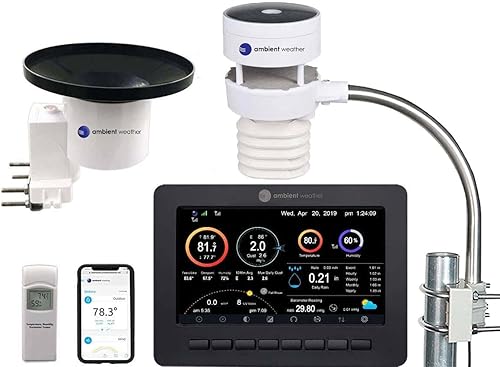
Its ultrasonic array has no moving parts in the wind sensor, and the system includes a rain cup and an indoor thermo-hygrometer-barometer. The stated RF range is up to 1,000 feet line of sight in open air.
Pros
- No moving parts in the ultrasonic wind sensor
- Five-second updates
- Indoor sensor included
Cons
- Higher-feature setup may be more than a basic user needs
- Mounting pole is not included
The WS-5000 stands out for its ultrasonic wind sensor with no moving parts. It sends updates every five seconds, and the system includes a rain cup, full-color console and an indoor sensor for temperature, humidity and barometric pressure.
Its sensor array also measures temperature, humidity, UV and solar radiation. The wireless range is up to 1,000 feet line of sight in open air, though obstacles and placement affect reception.
Choose this model if you want ultrasonic wind sensing and a broad sensor package. For the full model-specific breakdown, read our Ambient Weather WS-5000 review.
Ambient Weather WS-4000: Best for low-maintenance sensors

- Ultrasonic wind gauge
- Haptic rain gauge
- No moving parts in those gauges
- Color console and indoor sensor included
The WS-4000 combines ultrasonic wind sensing and a haptic rain gauge, both described as having no moving parts. It includes a color console and an indoor sensor for temperature, humidity and pressure.
Pros
- No moving parts in wind and rain gauges
- Indoor sensor included
- Remote monitoring and alerts
Cons
- Sensor update interval is not specified
- Check the mounting location before setup
The WS-4000 combines ultrasonic wind sensing with a haptic rain gauge, both with no moving parts. It also includes a color console and an indoor sensor for temperature, humidity and barometric pressure.
Its compact all-in-one design needs no tools for installation. It connects to Ambient Weather Network for remote monitoring, data analysis and alerts.
Choose it if low-maintenance sensor design and remote access matter more than a specified update interval. Check the mounting location and console placement before deciding where each part will go.
Ambient Weather WS-1965: Best for a straightforward array

- All-in-one sensor array
- Color LCD display
- Measures temperature, humidity, pressure, wind and rain
- Wi-Fi remote monitoring
This model pairs an all-in-one array with a color display. It provides remote monitoring and access to the Ambient Weather Network.
Pros
- All-in-one sensor array
- Color display included
- Remote monitoring and alerts
Cons
- Its listed core measurements do not include UV or solar radiation
- Sensor update timing is not specified
The WS-1965 pairs one all-in-one sensor array with a color LCD display. Its measurements include temperature, humidity, barometric pressure, wind speed, wind direction and rainfall.
Wi-Fi features provide remote monitoring and access to Ambient Weather Network. It is compatible with nine sensor models, which may help if you expect to expand your setup later.
Choose this model if those core readings meet your needs. Its listed measurements do not include UV or solar radiation, so consider another pick if those readings matter to you.
Ambient Weather WS-7078: Best for indoor and outdoor readings

- Color LCD display
- Outdoor wind, rain, temperature, humidity, UV and solar readings
- Indoor temperature, humidity and pressure
- Wi-Fi remote monitoring
The WS-7078 tracks a wide set of outdoor conditions and adds indoor temperature, humidity and pressure. Its console also shows feels-like temperature, moon phase and a pressure-based forecast.
Pros
- Indoor sensor measurements included
- UV and solar readings
- IFTTT support
Cons
- Sensor array requires 3 AA batteries
- Console needs an adapter for power
The WS-7078 adds indoor temperature, humidity and barometric pressure to outdoor readings for wind, rainfall, temperature, humidity, UV and solar radiation. Its color LCD console also displays feels-like temperature, moon phase and a pressure-based forecast.
The station supports Wi-Fi remote monitoring and IFTTT connections. Its console uses an adapter for power, while the outdoor array requires 3 AA batteries.
Choose it if you want both indoor and outdoor conditions in one setup. If display size is your priority, compare it with our weather stations with large displays.
Ambient Weather WS-1553-IP: Best for direct network options

- Outdoor sensor array and WEATHERHUB module
- Wi-Fi or direct Ethernet connection
- Measures wind, rain, temperature, humidity, UV and solar radiation
- 16-second updates
The WS-1553-IP sends weather data through its included WEATHERHUB module and supports Wi-Fi or direct Ethernet. It does not include a display console, so plan to view readings online or add a compatible console.
Pros
- Direct Ethernet option
- Remote monitoring and alerts
- Calibration and alarm features
Cons
- Display console is not included
- Decide how you want to view readings
The WS-1553-IP supports Wi-Fi or direct Ethernet through its included WEATHERHUB module. It measures wind, rainfall, temperature, humidity, UV and solar radiation, with readings every 16 seconds.
This model does not include a display console. You can view station data online, or use an optional add-on console.
Choose it when network access matters more than a bundled screen. Decide where you will view readings and whether you want to add a compatible console.
Ambient Weather WS-2801-X2: Best for remote temperature checks

- Color display console
- Three remote sensors included
- Supports up to three remote sensors
- 24 to 48 hour forecast
The WS-2801-X2 pairs a color forecast console with remote temperature and humidity sensors. It suits a home that needs readings from more than one indoor or outdoor spot.
Pros
- Three remote sensors included
- Supports up to three sensors
- Console calibration available
Cons
- Wi-Fi remote monitoring is not specified
- Backlight stays on with AC power
The WS-2801-X2 suits a home that wants a console and readings from several remote sensors. It includes three remote sensors and supports up to three, with a color display that forecasts the next 24 to 48 hours based on changes in barometric pressure.
Each remote sensor has an LCD display for temperature and humidity. This can help if you want to check readings in different rooms or areas.
Choose this model if multiple remote sensor locations matter more than online access. Its backlight stays on with AC power, while batteries serve as backup.
What should you compare before choosing?
Compare measurements, display and network access before focusing on smaller feature differences. A station is easier to use when it measures the conditions you care about and shows them where you want to check.
If you want wind, rain, temperature and humidity, several models here cover those basics. The WS-2902, WS-2000 and WS-5000 also measure UV and solar radiation outdoors.
Console preferences vary. The WS-2902 has a color LCD, the WS-2000 and WS-5000 have full-color TFT displays, and the WS-1553-IP comes without a display console.
Decide whether you need indoor readings, too. The WS-5000 and WS-4000 include an indoor sensor, the WS-7078 measures indoor conditions, and the WS-2000 supports an optional indoor sensor.
Is an ultrasonic Ambient Weather station right for you?
An ultrasonic model may suit you if you want wind sensing without moving parts. The WS-5000 and WS-4000 both use ultrasonic wind sensors, while the WS-5000 specifies five-second updates.
The WS-5000 includes a rain cup, while the WS-4000 uses a haptic rain gauge. Compare these sensor setups against your preferences and maintenance needs.
For more detail on sensor design, read our ultrasonic and mechanical anemometer comparison. To compare brands, see our Tempest vs Ambient Weather comparison.
How should you plan placement and power?
Plan the sensor location before choosing a station, since signal path and mounting access can affect setup. Several models use wireless RF between an outdoor array and a console, and stated ranges assume open-air line of sight.
The WS-2902 and WS-2000 arrays use a solar panel as their primary power source, with optional battery backup. The WS-5000 also includes a solar panel, while the WS-7078 array uses batteries.
Many arrays mount to a pole, and a pole may not be included. Our roof mount or tripod placement guide can help you plan a location with useful exposure and a workable support.
Which Ambient Weather station should you choose?
Pick the WS-2902 for a balanced home setup with a local color console, broad outdoor measurements and Wi-Fi access. Choose the WS-5000 if ultrasonic wind sensing and five-second updates are central to your decision.
The WS-2000 fits buyers who want detailed console options, while the WS-2801-X2 suits homes that need several remote sensor locations. Consider the WS-1553-IP if you prefer a network-focused setup without a bundled display.
Our top 3 picks at a glance
-
1
-
2
-
3
Frequently asked questions
Which Ambient Weather station is best for most homes?
The WS-2902 is a balanced choice for many homes because it combines a color display, measurements for wind, temperature, humidity, rainfall, UV and solar radiation, plus Wi-Fi features. Choose a different model if you specifically want ultrasonic wind sensing, detailed console options or multiple remote sensors.
What is the difference between the WS-2000 and WS-5000?
The WS-2000 uses a wireless all-in-one sensor array and a high-definition color TFT console. The WS-5000 has an ultrasonic array with no moving parts, updates every five seconds and includes an indoor sensor.
See our WS-5000 vs WS-2000 comparison for details.
Do Ambient Weather stations work with Wi-Fi?
Several models here support Wi-Fi features, remote monitoring or optional publishing to the Ambient Weather Network. The WS-1553-IP also supports a direct Ethernet connection through its WEATHERHUB module.
Consider whether you want a local console, online dashboard or both.
Do Ambient Weather stations include an indoor sensor?
Some do. The WS-5000 and WS-4000 include an indoor sensor for temperature, humidity and barometric pressure, while the WS-7078 measures indoor conditions.
The WS-2000 can receive readings from an optional indoor sensor, sold separately.