9 Best Reliable Home Weather Stations (November 2026)
The best most reliable home weather stations include the Newentor Weather Station Wireless Indoor Outdoor Thermometer for most homes, the DreamSky Weather Station Indoor Outdoor Thermometer Wireless for easy reading, and the La Crosse Technology Advanced for color forecasts.
On this page (5 sections)
The most reliable home weather station for most homes is the Newentor Weather Station Wireless Indoor Outdoor Thermometer, because it stays on with wall power, keeps atomic time, and adds sensors later without a new console. If your day depends on wind and rain totals, the Ambient Weather WS-2902 is the better fit.
Reliability here means the station keeps showing the same numbers day in and day out, not the biggest feature list. Three things matter most: steady power, a strong wireless link, and a sensor that reads the range your climate throws at it.
A station that dims its screen or drops the sensor link on a cold night is not reliable, no matter how many icons it draws. The picks below are grouped by the job they do best, so you can start with where the console will sit and what you need it to tell you.
This guide skips the beginner tour. If you want the basics first, our how does a weather station work explainer covers sensors and consoles.
Otherwise, read on for the picks and the checks that separate a dependable unit from a fussy one.
Our picks at a glance
-
1
 Best for most homes
Newentor Weather Station Wireless Indoor Outdoor Thermometer
9.6/10 our score
See it on Amazon -
2
 Best for easy reading
DreamSky Weather Station Indoor Outdoor Thermometer Wireless
9.5/10 our score
See it on Amazon -
3

- 4
 Best for simple setupCheck it
- 5
 Best for full weather dataCheck it
- 6
 Check it
LICHI Indoor Outdoor Thermometer Wireless Weather Station
Best for wide temperature range - 7
 Check it
Sainlogic 12-in-1 Wireless Station
Best for large yards - 8
 Best for historical dataCheck it
- 9
 Best for comfort trackingCheck it
The most reliable home weather station picks, ranked
The top pick suits most readers, and each pick below wins on a specific need, from wind data to extreme cold. We rank by score, and the differences come down to power design and sensor coverage.
Newentor Weather Station Wireless Indoor Outdoor Thermometer: Best for most homes
- Color LCD with adjustable backlight
- Up to 3 wireless sensors
- Atomic clock with dual alarms
- Adapter power with battery backup
A plug-in color display that keeps running through short outages and reads clearly in low light. Support for three sensors lets you track a second room or a shed without buying a new console.
Pros
- Adapter power keeps the screen on all day
- Three sensor channels
- Atomic time and date
Cons
- Single outdoor sensor in the box
- Battery-only mode dims after 15 seconds
Newentor is the easiest station here to live with because it plugs in and keeps a full-color screen lit around the clock. The adapter removes the daily battery drain that shortens the life of battery-only consoles, and the backup batteries keep the clock and readings alive through an outage.
The three sensor channels are the quiet advantage. Add a second outdoor sensor for a garage or greenhouse and the console cycles through both, so one screen covers two locations.
Daily highs and lows plus customizable alerts let you spot a cold snap before the plants notice.
Atomic time sets itself, and the dual alarms make it a bedside clock as well. The display measures roughly 8 in wide and 5 in tall, so it needs real counter space but stays readable from across the kitchen.
Weather forecast, moon phase and barometric pressure round out the screen.
The trade-off is that only one sensor ships in the box. Buy extra sensors if you need a second location, and plan on wall power for the always-on display, because battery mode dims the screen after 15 seconds.
DreamSky Weather Station Indoor Outdoor Thermometer Wireless: Best for easy reading
- Large colorful display
- WWVB atomic clock with auto DST
- 5 backlight levels
- USB charging port
Big numbers and a dimmer make it the friendliest choice for a bedroom or living room. The atomic clock resets itself for daylight saving, so you stop touching the time twice a year.
Pros
- Large numbers readable from across a room
- Five brightness levels
- Auto daylight saving adjustment
Cons
- Sensor and console need line-of-sight wiring care
- Battery-only mode dims the screen
DreamSky targets the reader who wants to read the weather from the couch. The large colorful display puts temperature and forecast in big numbers, and five backlight levels let you dim it to something comfortable at night.
The console is about 8 in wide and 5 in tall, close to a small tablet.
Its atomic clock pulls the WWVB signal and adjusts for daylight saving on its own, which saves the twice-yearly reset that trips up cheaper stations. A USB port on the back adds a handy charging point on a bedside table.
High and low temperature alerts keep you ahead of a cold night, and the console handles up to three sensors for multiple rooms. The forecast calibrates over about 7 days at your local pressure, and the outdoor sensor runs on its own batteries for the wireless link.
What holds it back is the adapter dependence for full brightness. Battery-only use lights the screen for 10 seconds before it dims, so treat it as a plug-in station.
If the screen ever looks dim during setup, the station is either searching for the atomic signal or running on batteries, not broken.
La Crosse Technology Advanced: Best for color forecasts
- Dynamic color forecast icons
- Heat index and dew point
- Atomic time with DST reset
- 330 ft sensor range
A colorful forecast panel that flags temperature swings before you feel them. Dew point and heat index views help on muggy summer days and dry winter mornings.
Pros
- Trend arrows show where conditions are going
- Adjustable backlight levels
- Battery and temperature alert support
Cons
- Single sensor channel
- Forecast needs a week of calibration
La Crosse fits a living room where weather is part of the morning routine. Dynamic color forecast icons change with the trend, and arrows show whether pressure is rising or falling, so you get a sense of direction rather than a single snapshot.
The panel is about 8.4 in wide, with a black plastic body that blends into most shelves.
Dew point and heat index views are the features that matter in real weather. They tell you whether a hot day will feel sticky and whether a cool evening will feel damp, which plain temperature numbers hide.
Min and max records reset daily, so each morning starts fresh.
The wireless sensor reaches 330 ft in open air, enough for a backyard post and back. The backlight has high, low and off settings, and the console runs on a 5V adapter with an optional battery backup for short outages.
A time alarm with 10-minute snooze covers the bedside role.
The trade-off is a single sensor channel, so it tracks one outdoor spot. Customizable alerts are on hand when you want a heads-up for a freezing morning.
AcuRite 02077M: Best for simple setup
- Self-calibrating 12-hour forecast
- Moon phase
- Adjustable dimmer
- Signal strength indicator
A small console that hangs on a post or sits on a shelf and starts reading in minutes. It shows signal strength and battery status, which are the two things that quietly cause most false readings.
Pros
- Self-calibrating forecast
- Signal and battery indicators
- Compact footprint
Cons
- No extra sensor channels
- Fewer data points than larger consoles
AcuRite 02077M is the no-fuss starter. You hang the small outdoor sensor on a post with its built-in hanger, drop two AA batteries in, and the console begins reading.
Setup takes minutes and the display dims itself to match the room.
The self-calibrating forecast is the standout: the station learns local pressure patterns and projects about 12 hours ahead, which beats a fixed guess. Signal strength and low battery indicators sit on the screen, so you see a fading link before the readings go wrong.
Trend arrows and the current moon phase add context without clutter.
The console is compact at about 4.5 in wide and 6.6 in tall, which suits a desk, shelf or RV wall where space is tight. It won a spot on a Better Homes & Gardens list for its clear, colorful screen.
The outdoor sensor runs on two AA batteries, and the display uses an included AC adapter with optional battery backup.
There is one outdoor channel only, so a second location needs another station. This is the pick for a first home weather setup or a gift.
Ambient Weather WS-2902: Best for full weather data
- Wind speed and direction
- Rain gauge
- UV and solar radiation
- Wi-Fi with remote alerts
The pick when temperature and humidity are not enough and you want wind, rain, and solar figures in one place. Wi-Fi pulls the readings to your phone and to smart home routines.
Pros
- Measures wind and rainfall
- Solar power with battery backup
- Works with smart home setups
Cons
- Higher cost than indoor-outdoor consoles
- Sensor array needs a mounting pole
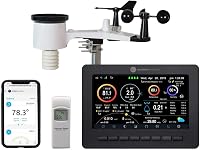
Ambient Weather WS-2902 is the step up when temperature readings stop being enough. The all-in-one Osprey array measures wind speed and direction, rainfall, UV and solar radiation alongside temperature and humidity, so you get a full backyard picture.
The console is a color LCD that lays the extra data out without crowding the temperature readout.
Wi-Fi connects the console to the Ambient Weather Network, and Alexa, Google Home and IFTTT support means you can trigger routines on conditions. Set an alert for wind gusts and the station can warn you before a storm reaches the patio furniture.
The online dashboard lets you customize tiles and share conditions.
The array runs on solar with a super capacitor and battery backup, which is why it keeps reporting through cloudy stretches without a cord. The RF link reaches 330 ft in open air, though walls and metal cut into that.
The array weighs close to 4 lb and clamps to a pole between 1.25 and 2 in with its U-bolt bracket.
The trade-off is a real installation: the array needs a mounting pole and open sky. That step is worth it for anyone who wants wind and rain accuracy.
Our professional home weather station guide covers this tier in more depth.
LICHI Indoor Outdoor Thermometer Wireless Weather Station: Best for wide temperature range
- Outdoor range from -40 °F to 158 °F
- 330 ft transmission
- 24-hour trend history
- Folding stand and hanging ring
The widest outdoor temperature span here makes it the pick for cold-climate sheds and hot porches. The battery-only design suits a spot without an outlet.
Pros
- Handles extreme outdoor cold and heat
- Three sensor channels
- Portable with a folding stand
Cons
- No plug-in option
- Backlight stays on for 10 seconds
LICHI is the pick for a place that gets genuinely cold or hot. The outdoor sensor reads from -40 °F to 158 °F, a wider band than anything else here, and it transmits to the console across 330 ft.
Indoor readings run from 14.2 °F to 122 °F, and humidity covers 1% to 99%.
That range suits a cabin, a cold shed or a desert porch where a standard sensor would fall short. The station records 24 hours of temperature and humidity trends, so you can see overnight lows at a glance.
It also predicts the next 12 to 24 hours from a built-in pressure sensor.
A folding stand and hanging ring let it move between a wall and a table, and the 4 in LCD keeps readings compact. It takes 3 AAA batteries for the console and 2 AA for the sensor, and it supports three sensors.
The sensor refreshes every 30 seconds.
The cost of that portability is battery-only power. There is no adapter, so you swap batteries more often than on a plug-in model, and the backlight only stays on for 10 seconds when you tap it.
Sainlogic 12-in-1 Wireless Station: Best for large yards
- Rain gauge with ±1 mm light-rain precision
- Wind speed and direction
- 6.5 in display
- Solar power with battery backup
A big screen and a full outdoor array for orchards, farms, and wide backyards. The bold fonts suit a kitchen wall or a shed where you read from a distance.
Pros
- Large bold display
- Rainfall, wind, dew point and pressure
- No Wi-Fi needed
Cons
- No Wi-Fi or app access
- Array needs open sky and a pole
Sainlogic covers large properties where a single post is far from the house. The outdoor array measures wind, rain and pressure and transmits without Wi-Fi, which suits orchards, farms and ranches where the router does not reach.
It also reads dew point and perceived temperature.
The 6.5 in screen with three backlight levels carries bold fonts, so readings stay legible from across a kitchen. Rainfall tracks to ±1 mm in light rain and about ±7% in heavy rain, with manual calibration for local tweaks.
Swiss-made temperature and humidity sensors hold accuracy to about ±2 °F.
Solar power with battery backup keeps it running through long days without a cord, and setup takes minutes with the included manual. Custom alerts flag conditions worth acting on, and pressure reads across 300 to 1100 hPa.
The trade-off is no app or online dashboard, so readings stay on the console. That is a fair exchange if you want a dependable, self-contained unit.
For app-based options, see our smart weather station roundup.
AcuRite Iris 01512: Best for historical data
- Over 55 data points
- Wind, rain and pressure
- Personalized 12-hour forecast
- Adjustable color dimmer
The console keeps a running record, so you can compare today with the same date last month. Self-calibrating pressure sharpens the forecast the longer it runs.
Pros
- Deep historical record
- Wind, rain and pressure on one screen
- Forecast learns your elevation
Cons
- Bulky sensor setup
- Needs a week or more to calibrate
AcuRite Iris is built for readers who like records. It offers more than 55 data points, including historical highs and lows, heat index, dew point and pressure trends, all on one color screen.
The display is large, about 8 in wide, with an adjustable dimmer for evening use.
The forecast learns your elevation and pressure over time, so it gets sharper the longer it runs. The station takes thousands of pressure readings at 12-minute intervals to build a running average for your exact location.
Wind, rain and humidity arrive from the outdoor array on a 433 MHz link.
This is the station for someone who wants to compare this month with last and watch a pattern build. A 1000-hour battery rating covers the array, and the console runs on corded electric power.
It suits a home, office or garden post.
The trade-off is a bigger installation and a calibration window of two weeks or more before the forecast settles. Plan for a pole and a little patience.
La Crosse C85845: Best for comfort tracking
- Comfort level bars
- Heat index and dew point
- Custom high and low alerts
- Atomic time with DST option
The comfort bars turn humidity numbers into a quick read on whether a room feels stuffy or dry. Custom alerts cut the guesswork about opening windows.
Pros
- Comfort bars for indoor and outdoor humidity
- Custom temperature and humidity alerts
- Large clear digits
Cons
- No wind or rain sensors
- Barometer needs 7 to 10 days to settle
La Crosse C85845 turns humidity into something you can act on. Comfort level bars color-code indoor and outdoor humidity, so a stuffy bedroom or a damp basement shows up at a glance instead of as a number you have to interpret.
The bars cover 10% to 99% RH.
Custom high and low alerts work for both temperature and humidity, which makes it a useful tool for a nursery or a plant room. Heat index and dew point views are there when summer gets sticky, and daily highs and lows reset each day.
The console runs on a 5V adapter with battery backup, so the backlight stays on, and atomic time resets for daylight saving with an on/off option across seven time zones. Digits are large and the layout is clean.
A crescendo alarm with 10-minute snooze adds a gentle wake-up.
The barometer needs 7 to 10 days to calibrate before the forecast icons settle. It also has no wind or rain sensor, so treat it as an indoor comfort and forecast station, not a full backyard array.
How these picks compare on the specs that matter
The table below lines up power, sensor channels and outdoor temperature range, the three specs that decide whether a station stays dependable through a year of weather.
| Product | Best for | Sensors | Outdoor low | Power | Our score |
|---|---|---|---|---|---|
| Newentor Weather Station Wireless Indoor Outdoor Thermometer | most homes | 1 included, 3 channels | 14 °F | DC adapter with battery backup | 9.6 |
| DreamSky Weather Station Indoor Outdoor Thermometer Wireless | easy reading | 1 included, 3 channels | Adapter with battery backup | 9.5 | |
| La Crosse Technology Advanced | color forecasts | 1 outdoor sensor | AC adapter with battery backup | 9.4 | |
| AcuRite 02077M | simple setup | 1 outdoor sensor | AC adapter with battery backup | 9.3 | |
| Ambient Weather WS-2902 | full weather data | All-in-one array | Solar with battery backup | 9.1 | |
| LICHI Indoor Outdoor Thermometer Wireless Weather Station | wide temperature range | 1 included, 3 channels | Battery only | 9.0 | |
| Sainlogic 12-in-1 Wireless Station | large yards | All-in-one outdoor array | Solar with battery backup | 8.6 | |
| AcuRite Iris 01512 | historical data | Outdoor wind and rain array | Corded electric | 8.4 | |
| La Crosse C85845 | comfort tracking | 1 outdoor sensor | AC adapter with battery backup | 8.3 |
How we compared these stations
We compared specs, power design and sensor coverage against what a homeowner actually needs. Every pick gets a score that weighs its specs and features against the job the keyword searcher is shopping for.
The first cut was power. Stations with an adapter and battery backup hold up better in daily use than battery-only consoles, because a dim screen is not a failure but a flat battery is.
A backup battery that carries the clock through an outage also saves a full reset.
Next came sensor range and channels. A station that reads 14 °F is fine in most of the country but not in a cold shed, and a console that accepts three sensors covers more of a property without a second purchase.
Wireless range and mounting needs were weighed with that.
Calibration time and timekeeping came last. Atomic clocks and self-calibrating forecasts are not glamorous, but they are what keeps a station trustworthy month after month.
We also noted what each station leaves out, such as Wi-Fi or an adapter, so the trade-offs stay visible.
Questions to ask before you buy a home weather station
The answer depends on three things: where the sensor goes, how cold it gets, and whether you want wind and rain. Start there, then match the features.
What does a reliable station actually need?
Reliable means steady power, a sensor that handles your climate, and a console that keeps time and calibrates itself. An adapter with battery backup covers the first part.
Sensor channels and range cover the second. Atomic time and a self-calibrating forecast cover the third, so the station does not drift or guess.
Signal strength and low battery indicators are the small extras that let you catch a problem early.
Should the station be plug-in, battery, or both?
Both is best. Plug-in power keeps the screen readable all day, and batteries carry the clock and readings through a short outage.
Every station here except the LICHI offers that combination.
Battery-only models save a cord but dim the screen quickly and need more frequent battery changes. The LICHI is still the right call when there is no outlet within reach, as long as you accept the battery routine.
For a fixed spot with an outlet, pick a station that takes an adapter.
How much outdoor temperature range do you need?
Most homes are fine with a sensor rated to about 14 °F, which covers typical winters. That is the rating on the Newentor and the Ambient Weather array.
If you track a shed, cabin or cold frame, pick a sensor rated to -40 °F like the LICHI.
Check your typical winter low before choosing. A sensor that stops reading in a cold snap is the most common reliability complaint in a cold climate.
Also match the high end: a hot porch needs a sensor that reads well past 100 °F.
Do you need wind and rain, or just temperature?
Temperature and humidity cover most indoor comfort and planning needs. Wind and rainfall matter if you garden, sail, or want a full picture of storms.
The Ambient Weather WS-2902, Sainlogic and AcuRite Iris all measure wind and rain.
Full-array stations cost more and need a pole. For a kitchen wall or bedside, a temperature and humidity console is enough.
Pick the array only when the extra data changes a decision you actually make.
Does a newer display make a station more reliable?
Not by itself. A color screen is easier to read, but the dependable parts are the sensor, the wireless link and the power.
A plain LCD that holds its readings beats a bright screen that drops the link.
Judge a station by its range ratings and backup design first. Pick the screen brightness and size that suits where it will sit.
A dimmer is worth having for a bedroom, and large digits matter more than color for a kitchen wall.
How do you keep the wireless link strong?
Mount the sensor within range and in sight of the console where you can. Walls, metal and distance all weaken the signal, so keep the pairing within a few hundred feet of open air.
A sensor mounted on solid metal will lose the link even at short range.
Check the signal strength indicator after setup, and replace sensor batteries at the first sign of a gap. Lithium cells hold up better in freezing weather.
A strong link is the simplest reliability upgrade.
For broader coverage of the category, our weather station buying guide covers entry-level models and what each type does well.
The verdict: which home weather station to trust
For most homes, the Newentor Weather Station Wireless Indoor Outdoor Thermometer is the most reliable home weather station you can pick, because adapter power, atomic time and three sensor channels cover the basics that fail on cheaper units. Pick the DreamSky if you want big numbers for a bedroom, the Ambient Weather WS-2902 if wind and rain matter, or the LICHI if your sensor lives somewhere that hits -40 °F.
The decision rule is simple. Plug-in and one sensor for a kitchen or bedside.
A full array on a pole for a gardener or storm watcher. A wide-range battery station for a cold shed.
Match the station to the job and it will read true for years.
Our top 3 picks at a glance
-
1
Best for most homes
Newentor Weather Station Wireless Indoor Outdoor Thermometer
9.6/10 our score
See it on Amazon -
2
Best for easy reading
DreamSky Weather Station Indoor Outdoor Thermometer Wireless
9.5/10 our score
See it on Amazon -
3
Frequently asked questions
How long do wireless weather station sensors last?
Most outdoor sensors run a year or more on fresh alkaline batteries, but cold weather shortens that. Lithium batteries hold up better in freezing temperatures.
Do I need Wi-Fi on a home weather station?
No. A radio-frequency console works without internet and is simpler to set up.
Choose Wi-Fi only if you want readings on your phone or smart home routines.
Why does my station's forecast take days to settle?
Barometric calibration needs a stretch of local pressure readings. La Crosse asks for 7 to 10 days and AcuRite Iris learns over 14 days or more.
What range should the outdoor sensor have?
Look for 300 ft or more of open-air range, then plan for walls and floors to cut into it. Keep the sensor within sight of the console where you can.
Can I add more sensors to one console?
Some consoles support up to three wireless channels. Newentor, DreamSky and LICHI each take three, which covers a garage, a shed and an outdoor post.