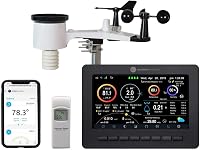
9 Best Professional Home Weather Stations (November 2026)
The best professional home weather stations include the Newentor Weather Station Wireless Indoor Outdoor Thermometer for most homes, the La Crosse Technology Advanced Weather Station for precise timekeeping, and the Tempest Weather Station for smart home integration.
On this page (6 sections)
- Best professional home weather stations for every backyard
- How these professional home weather stations compare
- How we compared these weather stations
- What should you look for in a professional home weather station?
- Which professional home weather station fits your home?
- The verdict on professional home weather stations
The best professional home weather station for most people is the Newentor Q3, because its color display is easy to read day or night, its atomic clock sets itself and it handles up to three sensors. The Tempest suits smart home setups, and the Ambient Weather WS-2000 fits anyone who wants to publish backyard data online.
The right station depends on the sensors you want and where you'll put it. A gardener needs rainfall and wind.
A bedside viewer needs a clear display and accurate time. A smart home fan needs app support.
The nine picks below cover those needs and the budgets around them.
Our weather station guide covers the wider market if you want more options. For a station that works with your phone and other devices, read our smart weather station roundup.
And if you're new to these devices, how does a weather station work explains the sensors in plain terms.
Our picks at a glance
-
1
 Best for most homes
Newentor Weather Station Wireless Indoor Outdoor Thermometer
9.6/10 our score
See it on Amazon -
2
 Best for precise timekeeping
La Crosse Technology Advanced Weather Station
9.4/10 our score
See it on Amazon -
3

- 4
 Best for sharing data onlineCheck it
- 5
 Best for storm trackingCheck it
- 6
 Check it
Sainlogic 12-in-1 Wireless Station
Best for large properties - 7
 Best for easy setupCheck it
- 8
 Best for comfort trackingCheck it
- 9
 Check it
Sainlogic 5GHz/2.4GHz Dual-Band WiFi Weather Station
Best for app alerts
Best professional home weather stations for every backyard
The Newentor Q3 is the strongest all-round choice for a typical home, while the rest of the list covers specialized jobs. Match the station to the weather you care about most before comparing extra features.
Every station here reads temperature and humidity, but they split into two families. One group centers on a color display, atomic time and alerts.
The other adds wind, rain and sometimes lightning on top.
Newentor Weather Station Wireless Indoor Outdoor Thermometer: Best for most homes
- Color LCD with adjustable backlight
- Atomic clock with dual alarms
- 3-channel wireless sensors
- 12-24 hour forecast
A bright color screen with atomic time and room for three sensors, at a price that leaves room for extra hardware.
Pros
- Color display is easy to read
- Atomic time sets itself
- Supports up to 3 remote sensors
Cons
- Battery mode dims the screen quickly
- No Wi-Fi or app support
Newentor fits a bedside table or kitchen counter where you want a full picture of the day's weather at a glance. The large color LCD shows indoor and outdoor temperature and humidity, daily highs and lows, alerts, a forecast and barometric pressure.
It measures 8.03 inches wide, 5.12 inches tall and 1.18 inches deep, so it sits well on a narrow nightstand. Its atomic clock sets the time and date automatically and includes dual alarms.
That makes it a usable alarm clock as well as a weather display. The station supports up to three remote sensors, though the box includes one.
That spare capacity lets you watch a greenhouse, a garage or a second room without buying a second station.
On battery power the screen dims after 15 seconds to save energy; plug in the DC adapter for an always-on display. It tracks a 12 to 24 hour forecast after 7 to 10 days of calibration.
The outdoor sensor reads down to 14 F. The body is ABS plastic and weighs 10 ounces.
Skip it if you need wind or rainfall readings. Choose it for temperature, humidity and time first.
If atomic time is your main want, our home weather stations with an atomic clock roundup covers more models.
La Crosse Technology Advanced Weather Station: Best for precise timekeeping
- Full-color forecast icons
- Atomic self-set time and date
- Customizable temperature alerts
- 330 ft sensor range
A color forecast station with atomic time and adjustable backlight, good for a nightstand or kitchen counter.
Pros
- Atomic time with DST reset
- Adjustable backlight settings
- Heat index and dew point views
Cons
- Runs on batteries only for full features
- No rainfall or wind sensors
La Crosse suits someone who wants a color forecast display with the most accurate time possible. The atomic self-set clock updates for daylight saving time and shows 12 or 24 hour modes.
The case measures 8.36 inches wide, 5.49 inches tall and 2.24 inches deep and weighs 12 ounces. The color icons show forecast trends, while the display also reads indoor and outdoor temperature and humidity with min/max records.
Customizable alerts warn you when conditions cross limits you set. The weather-resistant sensor reaches 330 ft with no obstructions.
That's enough to cross a large garden, though the signal weakens when walls or metal get in the way. Heat index and dew point views help you judge how a summer day will feel.
An adjustable backlight offers high, low or off settings. It runs on a 5V power adapter, with optional battery backup for the display.
Three AAA alkaline batteries are needed for that backup and are not included. On battery only, the backlight lights on demand to save power.
This station lacks wind and rain sensors. Pick it for time accuracy and color forecasting, or move to a 5-in-1 model below if you want full backyard data.
The La Crosse C85845 further down adds comfort charts on top of similar timekeeping.
Tempest Weather Station: Best for smart home integration
- Solar-powered outdoor sensor
- No moving parts
- 1
- 000+ ft wireless range
- Alexa and IFTTT support
A single solar-powered device that measures wind, rain, UV and lightning, with app and smart home integration.
Pros
- No moving parts to maintain
- Solar powered
- Works with Alexa and IFTTT
Cons
- No physical display
- Needs the app for all readings
Tempest suits a smart home where the weather feeds other devices. One solar-powered outdoor unit measures temperature, humidity, pressure, wind speed and direction, dew point, solar radiation, UV index, lightning and rainfall.
The unit measures 8.25 inches wide, 8.5 inches tall and 4.19 inches deep and weighs 1.6 pounds. It ships with an included lithium ion battery.
It has no moving parts, so there are no cups or vanes to clean or replace. The sensor sends updates every 3 seconds and reaches 1,000+ ft wirelessly.
It works with Alexa, Rachio, IFTTT and other smart platforms, so you can automate lights, irrigation or a thermostat from your backyard readings. The solar panel keeps the battery topped up, so there's no routine charging.
The trade-off is that there's no physical display. Every reading lives in the app.
If you like a screen on the wall, the Newentor or Ambient Weather suits you better. If you'd rather not mount a separate array and console, Tempest is the simpler install.
Just plan on checking your phone for the daily numbers.
Ambient Weather WS-2000: Best for sharing data online
- TFT color display
- Wi-Fi publishing
- All-in-one sensor array
- UV and solar radiation sensors
A complete station with a color console and Wi-Fi upload, aimed at people who want to share backyard data.
Pros
- Wi-Fi publishing to weather networks
- Full sensor array included
- Color TFT console
Cons
- Sensor array needs 3 AAA batteries
- Indoor sensor sold separately
Ambient Weather fits the person who wants to share their backyard data with the world. The Wi-Fi connection sends readings to online weather networks, and the color TFT console shows everything at once.
The console measures 6 inches wide, 12 inches tall and 14 inches deep, so plan real counter or shelf space. The all-in-one sensor array measures wind speed and direction, temperature, humidity, rainfall, UV and solar radiation.
The console also shows calculated values like feels-like temperature, dew point and 10 minute wind speed. It syncs its clock to an internet time server.
Sunrise, sunset, moon phase and forecast views round out the dashboard. The display supports light and dark backgrounds and both imperial and metric units.
The sensor array runs on solar power with optional 3 AAA batteries for backup. Its RF link reaches 330 ft in open air, though the brand notes 100 ft under typical conditions.
The array mounts on a pole 1.25 to 2 inches in diameter, and the pole is not included. An indoor temperature and humidity sensor is sold separately if you want room readings on the same console.
Skip it if you only want basic temperature and humidity. Its full array and Wi-Fi publishing are worth the extra cost when you'll use them.
The AcuRite Iris below matches its sensor count but adds lightning and skips Wi-Fi.
AcuRite Iris: Best for storm tracking
- Lightning detection within 25 miles
- 5-in-1 sensor array
- Color display with auto-dimming
- Over 50 data points
A 5-in-1 station with lightning detection and a weather ticker, for people who watch storms roll in.
Pros
- Lightning strike distance and counts
- Color display with ticker
- Over 50 data points
Cons
- Lightning detection adds cost over basic stations
- Display needs a power cord
AcuRite Iris suits a household that watches storms. Its lightning detection estimates the distance to lightning-producing storms and keeps a running count of strikes, plus weekly and monthly totals.
The station tracks lightning within 25 miles and shows records for the week, month and year. The 5-in-1 sensor measures temperature, humidity, wind speed and direction, pressure and rainfall.
The color display has auto-dimming brightness and a ticker that streams real-time information and alerts. It reports over 50 data points in total, including average wind speed at 1, 2, 5, 10 and 15 minute intervals.
Rainfall history covers the last 48 hours, seven days, the month and the year. It weighs 2 pounds and measures 6.8 inches wide, 8 inches tall and 1.3 inches deep.
It runs on six AA batteries and a power cord; the batteries are not included. AcuRite's self-calibrating forecast adjusts to your local pressure over time.
The brand says the station was named best overall by Better Homes & Gardens. The display's tilt-friendly stand also lets you set it on a counter or hang it on a wall.
Pick it when lightning awareness matters to you. For a plain temperature and time station, the Newentor Q3 costs less and covers the basics.
Sainlogic 12-in-1 Wireless Station: Best for large properties
- 6.5-inch screen with 3-level backlight
- Swiss temp and humidity sensor
- Rainfall accuracy of ±1 mm
- Solar powered with battery backup
A big-screen station with Swiss sensors and a wide wireless range, suited to orchards and farms.
Pros
- Large 6.5-inch display
- Swiss temp and humidity sensor
- Good rainfall precision
Cons
- No Wi-Fi
- Needs 3 AA batteries
Sainlogic suits a farm, orchard or large yard where the sensor sits far from the house. The 6.5 inch screen uses big bold fonts and three backlight levels, so older eyes can read it across a room.
The rainfall gauge tracks light rain to ±1 mm and heavy rain to ±7%. Swiss-made temperature and humidity sensors read from -40 F to 140 F, with accuracy of about ±2 F.
Humidity reads from 10% to 99%. The wireless sensor needs no wiring and mounts on poles, fences or rooftops.
It measures pressure from 300 to 1100 hPa and also reports dew point and feels-like temperature. That spread makes it useful in harsh climates, from a cold barn to a hot field.
The station runs on solar energy with 3 AA battery backup. Sainlogic offers US phone support on weekdays from 10 AM to 6 PM Eastern, plus email replies within 24 hours on weekdays and 48 hours on weekends.
The manual walks through calibration for local rain totals.
This model has no Wi-Fi. Choose it for a big screen and sturdy outdoor sensor, or step up to the dual-band Wi-Fi version below for app access.
AcuRite Iris 01512: Best for easy setup
- Over 55 data points
- Color LCD with dimmer
- Self-calibrating forecast
- Wireless 433 MHz sensor
A straightforward 5-in-1 station with a color screen and a forecast that learns your local pressure.
Pros
- Simple install and setup
- Color display with dimmer
- Over 55 data points
Cons
- No lightning detection
- Runs on a power cord
AcuRite's 01512 suits a first-time buyer who wants a full station without a complicated install. You install batteries, mount the outdoor sensor on a pole and you're set, as the brand describes the setup.
The mounting bracket is included. The color LCD shows the time and date with an adjustable dimmer.
The station reports over 55 data points, including historical data, heat index, dew point and pressure trends. Its forecast takes 4,000 readings at 12 minute increments to build a running average for your exact location.
After about 14 days, the self-calibrated pressure is reasonably accurate. The display measures 8.13 inches wide, 6.75 inches tall and 2.63 inches deep and weighs 5 pounds.
It runs on a cord and needs 10 AA batteries; batteries are not included. The outdoor sensor reads down to 32 F.
There's no lightning detection on this model, which is the main difference from the AcuRite Iris above.
Pick the 01512 if storms aren't your focus and you want the easiest possible setup. It's also the cheaper way to get a 5-in-1 sensor array and a color screen without paying for lightning hardware.
La Crosse C85845: Best for comfort tracking
- Comfort color bars for humidity
- Atomic time with DST reset
- Heat index and dew point views
- Adjustable backlight
A color station that tracks indoor comfort as well as outdoor conditions, with atomic time and alerts.
Pros
- Comfort charts for humidity
- Atomic time with DST reset
- Customizable temp and humidity alerts
Cons
- No wind or rainfall sensors
- Battery backup not included
La Crosse's C85845 suits someone who cares about indoor comfort as much as outdoor weather. Color comfort bars show humidity levels for both indoor and outdoor readings, so you can spot a dry room or a muggy backyard.
The bars run from 10% to 99% relative humidity.
The display measures 8.96 inches wide, 5.43 inches tall and 1.14 inches deep and weighs 12.8 ounces. The atomic clock sets itself and resets for daylight saving time.
You can set alerts for high and low temperature and humidity. Heat index and dew point views help on hot days.
The large display has adjustable brightness. It offers seven time zone settings and a crescendo alarm with a 10 minute snooze.
The dynamic forecast icons adjust to barometric pressure after a 7 to 10 day calibration. It runs on a 5V power cord with optional 3 AA battery backup.
On battery only, the backlight lights on demand to save power. The outdoor sensor needs two AA batteries, sold separately.
Skip it if you need wind or rain data. It's a strong pick for indoor comfort and timekeeping, not for full backyard weather.
The comfort bars make it the easiest station here for spotting a room that needs a humidifier or a vent.
Sainlogic 5GHz/2.4GHz Dual-Band WiFi Weather Station: Best for app alerts
- Dual-band Wi-Fi
- Swiss sensor chip
- 2-year data storage
- App alerts for key changes
A 12-in-1 station with app alerts and two years of stored data, for people who want readings on their phone.
Pros
- Dual-band Wi-Fi works with 5 GHz networks
- Two-year data storage with no subscription
- App alerts
Cons
- Setup needs the app
- Battery powered
Sainlogic's dual-band model suits a phone-first household. Its Wi-Fi works on both 5 GHz and 2.4 GHz networks, so it connects to more modern routers without a workaround.
Setup runs through the Inercom app in three steps, pairing over Bluetooth first. The display measures 6.7 inches wide, 5.2 inches tall and 1 inch deep and weighs 2.3 pounds.
The app sends alerts for temperature, humidity, pressure and other key changes. The station stores two years of data on the device with no subscription, and you can export it to Excel.
It reports 12 readings, including wind direction, average wind speed, rainfall, moon phase and forecast. Max and min records reset daily or on command.
The Swiss sensor chip gives ±0.2 C temperature precision and ±1.8% humidity precision. The wireless sensor reaches up to 443 ft in open areas.
It mounts four ways: top mount, top pole mount, side mount and side pole mount. It's battery powered and needs 3 AAA batteries, sold separately.
The app gives you remote checks when you're away from the display. Choose it for app alerts and long data history; choose a corded model for an always-on display.
The other Sainlogic here is the better fit if you want the screen to do the work without a phone.
How these professional home weather stations compare
The table lines up the key differences across the nine picks. Use it to see at a glance which stations include a display, which connect to Wi-Fi and which carry extra sensors.
Note the power source too. Corded and solar models keep their screens bright all the time, while battery-first models trade screen time for placement freedom.
| Product | Best for | Connectivity | Power source | Display type | Our score |
|---|---|---|---|---|---|
| Newentor Weather Station Wireless Indoor Outdoor Thermometer | most homes | Radio frequency | DC adapter or battery backup | LCD | 9.6 |
| La Crosse Technology Advanced Weather Station | precise timekeeping | Wi-Fi | Battery powered | LCD | 9.4 |
| Tempest Weather Station | smart home integration | 433 MHz or 868 MHz | Solar powered | No display | 9.0 |
| Ambient Weather WS-2000 | sharing data online | Wi-Fi | Solar powered | High definition | 8.8 |
| AcuRite Iris | storm tracking | Wireless | Corded electric | LCD | 8.7 |
| Sainlogic 12-in-1 Wireless Station | large properties | Wireless | Battery powered | LCD | 8.6 |
| AcuRite Iris 01512 | easy setup | Radio frequency | Corded electric | LCD | 8.4 |
| La Crosse C85845 | comfort tracking | Wireless | Corded electric | LED | 8.3 |
| Sainlogic 5GHz/2.4GHz Dual-Band WiFi Weather Station | app alerts | Radio frequency | Battery powered | LCD | 8.1 |
How we compared these weather stations
We scored each station against what a typical buyer wants from a best professional home weather station: useful sensors, an easy-to-read display and reliable timekeeping. Our score weighs specs, features and buyer feedback against what you're shopping for.
We looked at what each station measures. Temperature and humidity are the baseline.
Wind, rainfall, pressure and lightning are the extras that separate a pro-grade station from a simple thermometer. We also checked how each one connects: radio frequency to a display, Wi-Fi to an app, or both.
Display quality mattered too. Screen size, backlight controls and whether the display stays on with a cord or dims on batteries all affect daily use.
Atomic time and forecast calibration got weight because they reduce setup fuss. A station that needs a week to learn your local pressure is fine as long as you know that going in.
Every score reflects how well a model serves the job it's placed in.
What should you look for in a professional home weather station?
Start with the sensors you'll actually use. Wind speed and rainfall matter for gardeners and storm watchers, while temperature and humidity cover most everyday needs.
Every station here measures temperature and humidity; only some add wind, rain and lightning. A display is the other big choice.
Corded displays stay bright all the time. Battery-only displays dim to save power.
If you want readings on your phone, Wi-Fi is the feature to check first. The station's wireless range between the outdoor sensor and the display also matters, since a long garden can put the two far apart.
Which sensors do you really need?
Temperature and humidity are the core pair. Add barometric pressure for forecasts and trend arrows.
Wind speed and direction suit sailors, gardeners and anyone tracking storms. Rainfall helps with irrigation decisions.
UV and solar radiation readings tell you how strong the sun is on a given day. Lightning detection is a specialty feature.
It fits households that want early warning of storms. On the wind side, check whether a station reports a 10 minute average or just an instant gust.
Average wind is more useful for planning, while a gust figure tells you how hard a front hit.
Should you pick a display or an app?
A display gives you an instant read without opening a phone. It's the better fit for a kitchen, bedside table or living room.
Look for adjustable brightness and a screen large enough to read from across the room. A color screen helps separate the readings at a glance.
An app gives you remote access and alerts wherever you are. Stations without a physical display, like the Tempest, rely on the app entirely.
Pick the display if you want zero phone dependence, or the app if you want remote checks. Some stations give you both: a color console at home and Wi-Fi to a phone app.
How do atomic clocks and forecasts help?
An atomic clock sets the time and date by radio signal, so it stays accurate without manual changes. Several stations here also reset for daylight saving time.
That matters if the station doubles as an alarm clock. Dual alarms and snooze are worth checking if you plan to keep it on a nightstand.
Forecast features need calibration time. Most models ask for 7 to 10 days before their personal forecast settles.
During that window, treat the icons as a rough guide and rely on your own eyes and the pressure reading. Stations that learn your local barometric pressure tend to improve over the first couple of weeks.
Where should the outdoor sensor go?
Mount the sensor in open air, away from walls, trees and heat sources. Wind and rain readings need clear exposure to be useful.
Keep it within the wireless range the station states, and avoid solid metal or ground between the sensor and the display. A pole, fence or rooftop mount works for most homes.
The Sainlogic models accept several mounting positions. For a big yard, check the stated range before you commit to a spot.
A 1,000+ ft rating like the Tempest's is a line-of-sight figure, so real-world distance shrinks once obstacles are in the way.
Which professional home weather station fits your home?
The answer depends on the data you want and how you like to read it. Here's how the picks split by buyer.
Best for most homes: Newentor Q3
The Newentor Q3 covers temperature, humidity, time, alerts and forecasts on a bright color screen. Its three-sensor support lets you watch more than one spot outdoors.
It's the pick when you want a clear, useful display without paying for wind or rain gear you won't use. Plug it into the wall and the screen stays lit around the clock.
Best for smart homes: Tempest
The Tempest replaces the wall display with an app and feeds your smart devices. One solar-powered unit handles wind, rain, UV and lightning with no moving parts.
Choose it if you already run Alexa or IFTTT and want your weather data to trigger other things. Its 1,000+ ft range and 3 second updates suit automation that needs to react fast.
Best for data sharing: Ambient Weather WS-2000
The WS-2000 publishes to online weather networks over Wi-Fi and includes a full sensor array with UV and solar readings. It fits the person who wants to contribute backyard data and see a complete dashboard on a color console.
The console's light and dark backgrounds keep it readable in different rooms.
The verdict on professional home weather stations
For most homes, the Newentor Q3 is the best professional home weather station to buy. Its color display, atomic clock and three-sensor support cover the everyday need at a reasonable cost.
The Tempest is the pick when you want smart home integration and no moving parts. The Ambient Weather WS-2000 wins for Wi-Fi data sharing, and the AcuRite Iris leads when lightning matters.
Pick by the sensor you care about most. If you want rainfall and wind, skip the basic color stations and move to a 5-in-1 model.
If time accuracy and indoor comfort are the goal, the La Crosse C85845 and Newentor Q3 do the job without extra hardware. Whichever you choose, mount the outdoor sensor in open air and give the forecast a week to calibrate.
That last step matters more than any single spec when you want a station that reads your yard, not the town ten miles away.
Our top 3 picks at a glance
-
1
Best for most homes
Newentor Weather Station Wireless Indoor Outdoor Thermometer
9.6/10 our score
See it on Amazon -
2
Best for precise timekeeping
La Crosse Technology Advanced Weather Station
9.4/10 our score
See it on Amazon -
3
Frequently asked questions
What makes a weather station professional rather than a basic thermometer?
A professional home weather station measures several weather variables at once, usually including wind speed and direction, rainfall, barometric pressure, temperature and humidity. Basic thermometers only show temperature and humidity.
The extra sensors are what let you track storms and make local forecasts.
Do I need Wi-Fi on a home weather station?
Wi-Fi is optional. It helps if you want readings on your phone, app alerts or data published to online weather networks.
Stations without Wi-Fi still show all their readings on the display.
Pick Wi-Fi when remote access matters, and skip it to save money.
How much does the best professional home weather station cost?
Prices vary by features. Basic color-display stations sit in the budget tier.
Models with full sensor arrays, Wi-Fi or lightning detection land in the mid-range to premium tier.
Decide which sensors you actually need before you compare models.
Where should I mount the outdoor sensor?
Mount it in an open spot away from walls, trees and heat sources like air conditioners. Wind and rain readings need clear exposure.
Keep the sensor within the wireless range your station states, and keep the display indoors where you can see it.
Can a weather station work without internet?
Every station on this list works without internet except the Tempest, which requires the app for readings.
Wi-Fi only adds remote access and app features.
If your internet drops, the outdoor sensor keeps sending data to the display over radio frequency.