9 Best Home Weather Stations With Barometric Pressure (November 2026)
The best home weather stations with barometric pressure include the La Crosse Technology 308-1417 for tracking pressure trends, the Newentor Q3 for a color bedside display, and the La Crosse Technology Advanced for color forecasts on a budget.
On this page (6 sections)
The best home weather station with barometric pressure for most homes is the La Crosse Technology 308-1417, because its 24-hour pressure graph and tendency arrows turn a single reading into a trend you can read in seconds. For wind and rain as well, the Ambient Weather WS-2902 is the fuller setup.
Barometric pressure is the part of a weather station that actually predicts. Temperature tells you what it feels like now; the pressure trend hints at what is coming in the next 12 hours.
Our score weighs specs, features and how well each station fits what a pressure shopper wants. It is a research score, not a test result.
Read how a weather station works first if the sensors are new to you.
Our picks at a glance
-
1

-
2

-
3

Best home weather stations with barometric pressure, by use
The top pick wins on pressure detail, while the rest of the list solves specific needs: a color bedside clock, a first station, or a full backyard setup. Each one gets a badge for the job it does best.
La Crosse Technology 308-1417: Best for tracking pressure trends
- Barometric pressure graph with past 24-hour view
- Dynamic forecast icons with tendency arrows
- Wireless sensor with 330 ft range
- Atomic self-set time and calendar
A dedicated pressure forecaster that shows the last day of readings as a graph, so you can see a falling or rising trend instead of a single number.
Pros
- 24-hour pressure history graph
- Forecast icons change with tendency
- 330 ft wireless range
Cons
- Battery powered only
- No wind or rain sensors
This is the pressure specialist. A 24-hour historical graph sits on the screen next to the changing forecast icons, so you can see the line climb or fall before the outlook shifts.
The outdoor sensor reaches 330 ft with no obstructions, which covers most yards and detached garages. Atomic time resets itself for daylight saving, and the calendar stays accurate without you touching it.
The screen shows indoor and outdoor temperature and humidity in Fahrenheit or Celsius, with MIN/MAX records for both.
Temperature alerts add the practical side: you can set a high or low mark and let the station watch the night for you. It runs on 3 AA batteries for the display and 2 AA in the sensor, so there is no cord to route.
The compact silver body is small enough for a shelf or a wall bracket.
The trade-off is scope. There is no wind vane and no rain gauge, so this is a forecast station rather than a full weather center.
If pressure trends are your main reason for buying, that is the right trade. Our weather station calibration guide covers the settle-in period this unit needs.
Newentor Q3: Best for a color bedside display
- Large color LCD with adjustable backlight
- Barometric pressure and 12 to 24 hour forecast
- Supports up to 3 remote sensors
- Atomic clock with dual alarms
A color weather clock that pairs a pressure reading with a 12 to 24 hour forecast and an adjustable backlight that works as a bedside clock.
Pros
- Always-on color display on adapter power
- Three sensor channels
- Dual alarms and atomic time
Cons
- Battery mode lights the screen for 15 seconds only
- No wind or rain sensors
Newentor suits the bedroom or living room. The large color LCD shows indoor and outdoor temperature and humidity, the pressure reading and trend, a 12 to 24 hour forecast, and the moon phase on one screen.
The backlight is the deciding feature. On the included DC adapter the display stays lit all the time; on battery power alone it lights for 15 seconds when you tap it.
That makes it a good clock by the bed and a lower-power screen in a hallway. Brightness is adjustable for day and night viewing.
Three sensor channels let you watch more than one spot, such as a garage and a back porch. Atomic time with dual alarms adds the bedside duties.
It calculates the forecast for the next 12 to 24 hours, with 7 to 10 days of calibration to settle into your location. Daily high and low records and customizable alerts keep the numbers useful.
The trade-off against the top pick is the pressure presentation. You get a live value and a trend, not a 24-hour graph.
Pick Newentor for the screen you look at every day and La Crosse for the pressure history. Note the wireless link only frees the sensor from wires; the display is not rechargeable.
La Crosse Technology Advanced: Best for color forecasts on a budget
- Full-color forecast icons with tendency
- Indoor and outdoor temperature and humidity
- Atomic time with DST reset
- Adjustable HI/LO/OFF backlight
A color forecast station that shows heat index and dew point alongside the pressure-driven outlook, with a backlight you can set to high, low or off.
Pros
- Color forecast icons with tendency
- Heat index and dew point views
- Adapter power with battery backup
Cons
- Battery-only use limits the backlight
- No wind or rain sensors
La Crosse's Advanced model sits between a forecaster and a full station. The full-color icons show the outlook with tendency arrows, and the display also reads out heat index and dew point.
That pair of readings matters more than most people expect. Heat index tells you how hot the air feels, and dew point tells you how sticky it is, both more useful than humidity alone on a summer afternoon.
The backlight has high, low and off settings.
Power comes from the 5V adapter, with 3 AAA batteries as backup so the time and settings survive a short outage. On battery only, the backlight works on demand to save power.
Atomic time resets for daylight saving and the clock switches between 12-hour and 24-hour views. A time alarm with a 10-minute snooze rounds it out.
Compared with the 308-1417, this one gives you color and comfort readings but not the pressure graph. Choose it if the color screen is what sells you and you still want a pressure-driven forecast.
Our roundup of the best weather stations for the home has more forecasters in this class.
AcuRite 02077M: Best for a first weather station

- Barometric pressure trends with trend arrows
- Self-calibrating 12-hour forecast
- Auto-dimming color LCD
- Moon phase display
A simple color station with an auto-dimming screen, pressure trend arrows and a forecast that calibrates itself over the first weeks in your home.
Pros
- Auto-dimming color display
- Self-calibrating forecast
- Moon phase and trend arrows
Cons
- Fewer readings than the full stations here
- No wind or rain sensors
AcuRite's 02077M is the easiest place to start. A self-calibrating forecast takes local pressure readings and refines its 12-hour outlook over the first couple of weeks, so it improves the longer it runs.
The color LCD dims itself automatically, which matters in a bedroom or a room that gets evening sun. Trend arrows next to the pressure and a moon phase round out the screen.
High and low temperature and humidity records are there when you want them, along with signal strength for the sensor.
The outdoor sensor hangs from a post or tree branch with an integrated hanger and runs on 2 AA batteries. The display runs from the included AC adapter, with 3 AA batteries as backup.
The station counts over 15 data points, from indoor temperature to the date.
The trade-off is depth. This station tracks temperature, humidity and pressure well but skips wind and rain, and its data points are fewer than the full Iris models.
That is fine for a first station; it is not a long-term backyard record. The compact body also fits a desk or a kitchen counter without crowding it.
Ambient Weather WS-2902: Best for a complete backyard setup

- Pressure plus wind, rain, UV and solar readings
- Wi-Fi with remote monitoring and alerts
- Works with Alexa and Google Home
- Solar-powered sensor array
The full package: a pressure-capable console plus a solar sensor array that adds wind, rain and UV, with Wi-Fi so you can check it away from home.
Pros
- Wind, rain, UV and solar readings
- Wi-Fi remote monitoring
- Solar-powered array
Cons
- Highest setup effort here
- Costs more than a forecaster
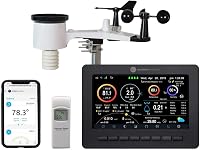
The WS-2902 is the complete option. Its solar-powered sensor array measures wind speed and direction, rainfall, UV intensity and solar radiation on top of pressure, temperature and humidity.
Wi-Fi is the reason to pay more. The console sends your data to the Ambient Weather Network, where you can build a dashboard and set alerts you can check from your phone.
It also works with Alexa and Google Home for smart-home routines. The console runs from an AC adapter with 3 AAA batteries as backup.
Setup takes more planning than a forecaster. The array mounts to a pole between 1.25 and 2 in diameter, and the radio link runs 330 ft in open air but will not pass through solid metal or ground.
The solar panel charges a super capacitor, with optional batteries for backup. Site the pole away from tall obstructions.
Against the top pick, this buys breadth rather than pressure detail. If you only want a pressure trend and a forecast, a forecaster is simpler and cheaper.
Pick this when a full weather record is the goal. Our smart weather station guide explains Wi-Fi models in more depth.
AcuRite Iris 01512: Best for pressure accuracy over time

- Pressure trends with trend arrow
- Self-calibrating forecast over 14 days
- Over 55 data points on a color screen
- Wind speed, direction and rainfall
A full color station whose pressure algorithm takes thousands of readings and improves its local forecast over the first two weeks of use.
Pros
- Pressure learning mode over 14 days
- Wind and rain included
- Adjustable display dimmer
Cons
- Longer calibration wait
- Corded power for the display
The Iris 01512 earns its badge on pressure accuracy over time. Its barometer takes readings at 12-minute intervals and builds a running average for your location, and AcuRite says the self-calibrated forecast is reasonably accurate after about 14 days.
That is a longer wait than the forecasters here, but the payoff is a forecast tuned to your exact elevation and air pressure. The color screen carries over 55 data points, including wind speed and direction and rainfall, plus historical records and heat index, dew point and feels-like temperature.
The display has an adjustable dimmer and runs from a cord. The outdoor sensor mounts to a pole or post with the included bracket.
Setup is just batteries and a mounting spot. The system runs on 10 AA batteries in total, with the display corded.
The trade-off is the calibration period and the cord. If you want a forecast this week, the 308-1417 or the 02077M gets you there sooner.
Choose the Iris when you plan to keep the station for years and want the readings to improve as it learns your location. Its rated low end of 32 F also makes it the least suited to hard freezes among the full stations.
La Crosse C85845: Best for humidity and comfort tracking

- Color comfort bars for indoor and outdoor humidity
- Dynamic forecast from pressure trend
- Heat index and dew point
- Atomic time with snooze alarm
A color station that leans into comfort, using colored humidity bars and heat index views to help you read indoor air quality at a glance.
Pros
- Comfort bars for humidity
- Large adjustable-brightness display
- Atomic time with snooze
Cons
- Forecast needs 7 to 10 days to calibrate
- No wind or rain sensors
La Crosse's C85845 is the comfort station. Colored comfort bars show indoor and outdoor humidity at a glance, so you can see when the air in a room turns too dry or too damp without reading numbers.
The scale runs from 10 to 99 percent relative humidity.
Heat index and dew point views sit alongside the dynamic forecast icons and tendency arrows. The large display has adjustable brightness and runs from the included 5V cord, with 3 AA batteries as backup if the power drops.
The screen spans nearly 9 inches across, so the readings are easy to read from across a room.
Atomic time with a snooze alarm and a full calendar cover the clock duties. The clock offers 12-hour or 24-hour mode and seven time zones.
La Crosse asks for 7 to 10 days of barometric calibration before the forecast settles.
The trade-off is narrower scope than the full Iris stations: no wind, no rain. Pick it if indoor comfort and humidity are what you notice most at home.
For pressure history specifically, the 308-1417 still wins. The comfort bars also help you spot a damp basement or a dry bedroom before the air feels wrong.
PENTASPI NC01: Best for monitoring several rooms

- Three wireless sensors in the box
- Pressure reading and trend indicator
- High and low temperature alarms
- USB or battery power
Ships with three sensors so you can watch temperature and humidity in a fridge, garage and bedroom while the main screen tracks pressure trends.
Pros
- Three sensors included
- Cold-room temperature alarms
- Color-coded sensor modules
Cons
- Pressure shown as a trend, not a graph
- No wind or rain sensors
The PENTASPI NC01 ships with three wireless sensors. That lets you watch a fridge, a garage and a bedroom from one color screen while the station also tracks barometric pressure and its trend.
The cold-room feature is the standout. The outdoor sensors read down to -4 F and carry high and low alarms, so you can set a warning for a freezer that drifts warm.
Color-coded modules keep the three locations straight. The top of the range reaches 158 F.
The screen shows a seven-symbol forecast based on the sensor data, plus MAX/MIN records and an indoor comfort icon. It runs from USB with three brightness levels or from batteries with a 10-second auto-dim.
The main unit is compact enough for a tabletop or a wall mount.
The trade-off against the top pick is pressure depth. You get a live reading and a trend indicator, not a history graph.
Choose this when monitoring several rooms matters more than tracking a pressure line. The smart weather station guide covers stations that add app access.
AcuRite Iris 01535M: Best for rain and pressure alerts

- Storm alarm when pressure drops
- Wind speed and direction
- Self-emptying rain gauge
- Over 25 data points on an HD display
A full Iris station that adds a storm alarm triggered by falling pressure, plus wind and rain sensors for a more complete backyard record.
Pros
- Storm alarm on pressure drop
- Rain gauge and wind sensors
- Custom alerts for wind and rain
Cons
- Fewer data points than the 01512
- Corded power for the display
The Iris 01535M adds one feature the others here do not have: a storm alarm that triggers when barometric pressure drops. If you want the station to tell you a front is moving in, this is the one that does it.
It also includes a self-emptying rain gauge and a wind vane and anemometer, plus over 25 data points on an HD display. Custom alerts cover temperature, humidity, wind speed and rainfall as well as pressure.
Rainfall history runs weekly, monthly and all-time.
The display shows time, date and day of the week and has a time alarm, so it can double as a bedside clock. The Iris line lets you add an optional lightning sensor later.
It runs on corded power with 4 AA batteries required.
The trade-off is that it carries fewer data points than the 01512 and needs corded power. Pick it for the storm alarm and the rain gauge; skip it if the deeper pressure history on the 01512 matters more to you.
The HD screen also lists moon phase and frost point, which suits a gardener watching cold nights.
How these home weather stations compare
Every station on this list reads barometric pressure. The differences are how much detail they give you, what else they measure, and how the screen fits into a room.
| Product | Best for | Pressure display | Forecast | Power | Our score |
|---|---|---|---|---|---|
| La Crosse Technology 308-1417 | tracking pressure trends | Graph with 24-hour history | Changing icons with tendency | Battery only, 5 AA | 9.7 |
| Newentor Q3 | a color bedside display | Live reading and trend | DC adapter or battery | 9.6 | |
| La Crosse Technology Advanced | color forecasts on a budget | Forecast based on pressure trend | 5V adapter, AAA backup | 9.4 | |
| AcuRite 02077M | a first weather station | Trends with arrows | Self-calibrating, 12 hours | AC adapter, AA backup | 9.3 |
| Ambient Weather WS-2902 | a complete backyard setup | Barometric pressure in full array | Solar array, adapter console | 9.1 | |
| AcuRite Iris 01512 | pressure accuracy over time | Trends with arrow | Corded electric | 8.4 | |
| La Crosse C85845 | humidity and comfort tracking | Forecast from pressure trend | 5V cord, AA backup | 8.3 | |
| PENTASPI NC01 | monitoring several rooms | Value and trend | USB or battery | 8.1 | |
| AcuRite Iris 01535M | rain and pressure alerts | Barometer with storm alarm | Corded electric | 7.8 |
The forecasters cluster at the top because they put pressure front and center. The full stations score lower here because their barometer is one reading among many, even though they measure far more.
What separates a forecaster from a full station
A forecaster pairs a pressure sensor with a display and one outdoor temperature and humidity sensor. Its whole job is the outlook and the indoor comfort reading.
A full station adds an array with wind, rain and sometimes UV and solar sensors. That array needs mounting, alignment and a clear patch of sky, and its readings feed a bigger dashboard.
If you only want to know whether to carry an umbrella, the forecaster does the job with less fuss.
How each pressure display ranks
The 308-1417 leads with a 24-hour historical graph. The Iris 01512 and 01535M follow with trend arrows and a barometer tied to self-calibrating forecasts.
Newentor, the La Crosse Advanced and C85845 show a live value and a trend, and the PENTASPI shows a value with a trend indicator. The 02077M sits with the trend-arrow group, backed by its self-calibrating 12-hour forecast.
Rank your shortlist by this column first, because it is the reading you will look at most.
How we compared these stations
We started from the pressure display. A station that shows a 24-hour graph or trend arrows gives you more to act on than one that shows a single number.
After that we weighed the extra sensors, the screen, the power options and the wireless range.
The forecasters sit at the top of this list because they fit the keyword best. The full stations score lower here because their pressure presentation is a smaller part of a much bigger system.
Our score weighs specs, features and how well each station fits what a pressure shopper wants.
Why the full stations still make the list
They earn a place because pressure does not act alone. A falling barometer plus a rain gauge and an anemometer tells a fuller story than the trend alone.
If you plan to keep records over seasons, the extra sensors pay off even though the pressure display is less detailed. The list stays ordered by how well each unit serves a pressure shopper, not by how many sensors it carries.
Power and placement, in practice
Battery-only units go anywhere without a cord but dim or blank the screen to save power. Adapter-powered units keep the display always on and brighter.
The 308-1417 runs on batteries only, so it can go almost anywhere. Newentor, the La Crosse Advanced, the C85845 and the 02077M run on adapters with battery backup.
The Iris models and the WS-2902 console run from cords. Match this to where the screen will sit before you buy.
What should you look for in a home weather station with barometric pressure?
Buy for the pressure display first. A trend arrow or a 24-hour graph tells you which way the weather is moving, while a bare number tells you almost nothing without a reference point.
Graph, trend arrow or number only
A historical graph is the most useful. It shows the last day of readings in one line, so you can see a steady fall before a storm.
Trend arrows are the next best thing, and a number with no trend is the least helpful.
How long the forecast takes to settle
Most stations need time to calibrate to your location. La Crosse asks for 7 to 10 days on its color models, and AcuRite's learning mode takes about 14 days.
Expect the forecast to improve in the first two weeks. A station that has just come out of the box may show a flat or drifting trend until it has collected enough local readings.
Sensors you actually want
Pressure alone covers the forecast. Add temperature and humidity for indoor comfort.
Add wind and rain only if you plan to keep a full backyard record. Three sensors, as on the PENTASPI, suit a fridge, garage and bedroom.
A full array like the WS-2902 or the Iris models suits someone who wants to compare seasons.
Screen and power
A color display with adjustable brightness is easier to read day and night. Adapter power keeps it always on; battery power saves energy but usually dims or blanks the screen.
Decide where the station will sit before you pick. A bedroom screen needs a dim night setting; a kitchen screen needs enough brightness for daylight.
Placement and wireless range
The outdoor sensor needs open air within the station's range, which runs to about 330 ft on the models here. Keep the display out of direct sun and away from heating vents so the indoor readings stay honest.
Radio signals will not pass through solid metal or earth, so keep the sensor in line of sight where you can.
Cold weather and outdoor sensor limits
Check the sensor's low end before you buy for a cold climate. The 308-1417 reads down to about -39.8 F.
The Newentor and WS-2902 sensors are rated to 14 F; the PENTASPI reads down to -4 F. The Iris 01512 is rated to 32 F.
For a garage or freezer, the PENTASPI's -4 F lower limit and alarms are the better fit.
For a backyard in a hard-freeze zone, the La Crosse 308-1417 and C85845 sensors tolerate the coldest nights.
Which home weather station with barometric pressure fits your home?
A pressure forecaster covers most homes. The 308-1417 is the best fit when you want to read the trend at a glance.
Newentor and the La Crosse Advanced suit bedrooms and living rooms where the screen is part of the furniture. AcuRite's 02077M is the easiest first station.
Go full station only if wind and rain are part of your plan. Then the Ambient WS-2902 gives you the most complete record with Wi-Fi, while the Iris models add rain and wind without the app.
Pick the C85845 if humidity comfort bars matter more than wind data, and the Iris 01535M if a storm alarm is what you are after.
Verdict
The La Crosse Technology 308-1417 is the best home weather station with barometric pressure for most homes. Its 24-hour graph and tendency arrows make the pressure trend readable in seconds, and the 330 ft sensor covers a normal yard.
Pick the Newentor Q3 for a color bedside display, the 02077M as a first station, or the WS-2902 when you want wind and rain with Wi-Fi on top. If comfort tracking matters most, the C85845 and its humidity bars are the one to get.
For pressure accuracy that grows over time, choose the Iris 01512 and give it two weeks. Read how a weather station works before you set yours up, and run a weather station calibration check after the first week to confirm the trend matches your local weather service.
Our top 3 picks at a glance
-
1
-
2
-
3
Frequently asked questions
Is barometric pressure accurate on a budget weather station?
Budget forecasters are accurate enough to show a usable trend once the station has settled in your home. Give it a week or two to calibrate, then compare the trend against your local weather service to see how well it tracks.
Do I need wind and rain sensors for a pressure station?
No. A pressure forecaster alone tells you when weather is changing, which is what many homes want.
Add wind and rain only if you plan to keep a full backyard record of conditions rather than a simple outlook.
Where should I place the pressure station in my home?
Place the display indoors on a shelf away from direct sun, heating vents and kitchen steam. Put the outdoor sensor outside at head height, shielded from rain and direct sun, within the station's stated wireless range.
How long does a pressure station take to forecast accurately?
Allow about 7 to 14 days. La Crosse asks for 7 to 10 days of barometric calibration on its color models, and AcuRite's learning mode takes 14 days.
The forecast improves as the station collects local readings.
Can a pressure weather station connect to my phone?
Only if it has Wi-Fi. The Ambient Weather WS-2902 connects to Wi-Fi for remote monitoring and smart-home alerts.
The forecaster models here use radio frequency to link the display and sensor, so you read them on the unit itself.