9 Best Home Weather Stations With Wind Speed (November 2026)
The best home weather stations with wind speed include the AcuRite Iris for most homes, the Ambient Weather WS-2902 for smart home integration, and the Tempest Weather Station for no-moving-parts simplicity.
On this page (4 sections)
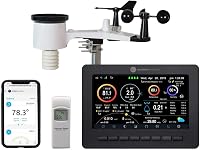
The best home weather station with wind speed for most homes is the AcuRite Iris (B07D9D6CXW). It combines an assembled 5-in-1 sensor with a color display and Wi-Fi upload to Weather Underground, so you get backyard wind readings and a shareable record without extra hardware.
Pick the Ambient Weather WS-2902 if you want smart home triggers from wind and rain data. Choose the Tempest if you'd rather skip a console and read everything in an app.
Wind speed is the hardest reading to get right at home. A sensor mounted too low or too close to a wall catches swirling air rather than the true breeze.
So the best station for you is the one whose sensor you can mount high and clear, and whose data you'll actually look at.
Our picks at a glance
-
1

-
2

-
3

- 4
 Best for a large color displayCheck it
- 5
 Best for lightning trackingCheck it
- 6
 Check it
Sainlogic 12-in-1 Wireless Station
Best for a big screen on a budget - 7
 Check it
La Crosse Technology 327-1417BW Wind Speed Weather
Best for a simple wind-focused console - 8
 Best for an easy first stationCheck it
- 9
 Check it
Sainlogic 7.5-Inch No-Wi-Fi Station
Best for reading without an app
How these home weather stations compare on wind and weather data
Every station here measures wind speed and direction, but they differ in what else they track, how they show it and whether they publish to the web. The ranking weighs those differences against what a home buyer needs most: reliable wind readings and data that's easy to reach.
Our score weighs specs, features and the station's fit with what you're shopping for. It isn't a lab rating.
We compared the sensor arrays, display types, connectivity and data sets each maker lists, then matched them to common backyard setups.
| Product | Best for | Connectivity | Display | Power source | Our score |
|---|---|---|---|---|---|
| AcuRite Iris | most homes | Wi-Fi, 433 MHz | Color LCD | Battery powered | 9.7 |
| Ambient Weather WS-2902 | smart home integration | Wi-Fi | Color LCD | Solar powered | 9.1 |
| Tempest Weather Station | no-moving-parts simplicity | 433 MHz or 868 MHz | No display | Solar powered | 9.0 |
| Ambient Weather WS-2000 | a large color display | Wi-Fi | High definition TFT | Solar powered | 8.8 |
| AcuRite Iris | lightning tracking | Wireless, Bluetooth | Color LCD | Corded electric | 8.7 |
| Sainlogic 12-in-1 Wireless Station | a big screen on a budget | Wireless | 6.5-inch LCD | Battery powered with solar backup | 8.6 |
| La Crosse Technology 327-1417BW Wind Speed Weather | a simple wind-focused console | 433 MHz | LCD | Battery powered | 8.1 |
| AcuRite Iris 01535M | an easy first station | Wireless, 433 MHz | HD LCD | Corded electric | 7.8 |
| Sainlogic 7.5-Inch No-Wi-Fi Station | reading without an app | Wireless | 7.5-inch color | Battery powered | 7.4 |
The best home weather stations with wind speed, ranked
Each pick below earns its place for a specific kind of buyer. Start with the AcuRite Iris for an all-round station, then move down the list for smart home links, app-only readings or a big budget display.
AcuRite Iris: Best for most homes
- 5-in-1 sensor with anemometer and wind vane
- Wi-Fi upload to Weather Underground
- Over 25 data points
- Color LCD with adjustable dimmer
A complete wind, rain and temperature station with Wi-Fi sharing and a readable color display. The best balance of data, setup and price tier here.
Pros
- Wi-Fi sharing to Weather Underground
- Over 25 data points with threshold alarms
- Assembled 5-in-1 sensor with anemometer and wind vane
Cons
- Battery powered, so plan for replacements
- Display is the only way to see readings without the web
The AcuRite Iris (B07D9D6CXW) is the strongest all-round pick for a typical backyard. Its 5-in-1 sensor arrives assembled and packs an anemometer, wind vane, rain gauge, thermometer and hygrometer into one housing.
The maker describes the setup as having no moving parts, so one pole and one mount cover your wind and rain needs.
The color LCD shows indoor and outdoor temperature and humidity, wind speed and direction, barometric pressure and rainfall, plus a forecast. The display has an adjustable dimmer and shows the time and date, so it works on a desk as well as on a wall.
Wi-Fi is the part that lifts it above the cheaper Iris models. The display uploads your data to Weather Underground, where more than 250,000 personal stations share readings.
You can check wind from your phone while you're away.
Over 25 data points support threshold alarms, so you can set a wind speed alert and get notified when gusts pick up. Readings also include heat index, dew point and wind chill.
The trade-off is that it's battery powered, so plan on replacements. Choose it if you want a complete station with web sharing.
Ambient Weather WS-2902: Best for smart home integration
- Osprey sensor array with rain cup
- UV and solar radiation readings
- IFTTT, Google Home and Alexa support
- Solar powered array
A solar-powered array that measures wind alongside UV and solar radiation. Smart home links let you trigger devices from backyard conditions.
Pros
- Works with IFTTT, Google Home and Alexa
- Solar-powered sensor array
- UV and solar radiation readings
Cons
- Sensor array needs battery backup for long cloudy spells
- Setup is more involved than a plug-and-read console
The Ambient Weather WS-2902 suits a smart home. Its Osprey sensor array measures wind speed and direction alongside temperature, humidity, rainfall, UV intensity and solar radiation.
The solar panel charges a super capacitor that runs the array, with optional battery backup for long cloudy stretches. It connects to the console over 915 MHz radio at up to 330 feet line of sight, or about 100 feet in typical conditions.
The array mounts to any pole between 1.25 and 2 inches across using the included U-bolt bracket, though the pole itself isn't included.
What sets it apart is the integration list. It works with IFTTT, Google Home and Alexa, so you can trigger lights or irrigation from backyard wind and rain.
You can also publish to the Ambient Weather Network.
The color LCD console shows the usual readings plus UV and solar data. Setup takes more steps than a plug-and-read unit because of the mounting bracket and network pairing.
Pick it if smart home automation is part of the plan. Otherwise the top Iris covers the basics with less fuss.
Tempest Weather Station: Best for no-moving-parts simplicity
- Built-in wind meter and rain gauge
- No moving parts
- Solar powered with 1,000+ ft wireless range
- Alexa, Rachio and IFTTT support
A single solar-powered unit with no moving parts, read through an app rather than a console. Updates land every 3 seconds and reach smart home platforms.
Pros
- No moving parts to wear out
- Real-time updates every 3 seconds
- Built-in lightning detection
Cons
- No physical display included
- App-only readings won't suit everyone
The Tempest Weather Station is the simplest hardware here. One solar-powered outdoor unit measures wind speed and direction, temperature, humidity, pressure, rainfall, UV, solar radiation and even lightning strikes.
It has no moving parts. Instead of spinning cups and a vane, the sensor reads the air electronically.
The maker bills it as near-zero maintenance, so there's nothing to wear out and nothing to free up after ice or debris.
The unit sends updates every 3 seconds and reaches 1,000+ feet wirelessly. It draws on a built-in lithium ion battery charged by its solar panel.
You read it in an app, not on a console. Alexa, Rachio and IFTTT support let you automate irrigation and more from real backyard conditions.
The missing piece is the display. If you like glancing at a console in the kitchen, this isn't that station.
The app is the interface, and it needs your phone or tablet.
Choose it if you want a low-maintenance sensor and you're happy with app readings. The absent console is the real trade-off against every other pick here.
Ambient Weather WS-2000: Best for a large color display
- TFT color display with light and dark backgrounds
- All-in-one sensor array with wind, rain and UV
- Calibration for all major parameters
- Wi-Fi publishing to personal weather networks
A step up from the WS-2902 for buyers who want a bigger, brighter console. The high-definition display shows wind and rain data at a glance.
Pros
- Large TFT color display
- Calibration for all major parameters
- Supports imperial and metric units
Cons
- Sensor array needs 3 AAA batteries as backup
- Optional indoor sensor sold separately
The Ambient Weather WS-2000 takes the WS-2902's sensor array and pairs it with a bigger, sharper console. The TFT color display switches between light and dark backgrounds and stays readable day or night.
It measures wind speed and direction, temperature, humidity, rainfall, UV and solar radiation. The console adds calculated fields like feels-like temperature, dew point, and 10-minute average wind speed and direction.
It also shows sunrise, sunset and moon phase, and syncs its clock over the internet.
Calibration is a headline feature. You can adjust all major parameters, which matters if your wind sensor sits in a spot with imperfect exposure.
The console supports imperial and metric units and publishes data to personal weather networks over Wi-Fi.
The array uses a solar panel with 3 AAA batteries as backup. An optional indoor sensor is sold separately if you want separate room readings.
Pick it over the WS-2902 if the display matters to you. The bigger screen and calibration controls justify the step up.
AcuRite Iris: Best for lightning tracking
- Lightning detection with distance estimate
- Running, weekly and monthly strike counts
- Over 50 data points
- Auto-dimming color display
The Iris sensor with lightning detection built in. It estimates storm distance and keeps strike records alongside wind and rain data.
Pros
- Lightning distance estimate and strike counter
- Over 50 data points
- Corded power for the display
Cons
- No Wi-Fi upload
- Corded display limits where you can place it
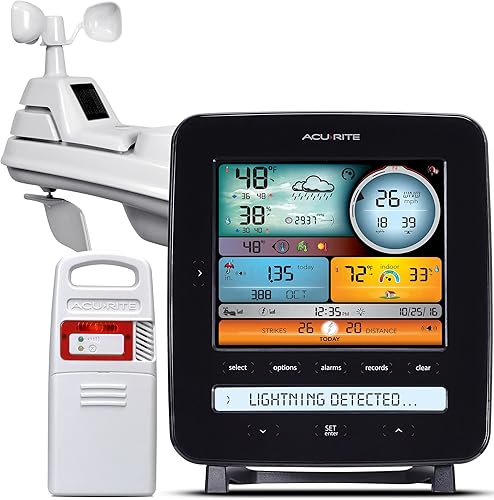
This AcuRite Iris (B01MEFGGMF) adds lightning detection to the 5-in-1 sensor. It estimates the distance to lightning-producing storms and keeps a running, weekly and monthly strike count.
Wind speed and direction, temperature, humidity, pressure and rainfall all still land on the auto-dimming color display. The data set runs to over 50 points, including pressure trends, heat index, dew point, feels-like temperature and rainfall records.
A weather ticker streams alerts across the bottom of the screen.
The display runs on corded power, so it stays lit without battery changes. That's a real advantage if the console lives on a desk or counter all day.
The station itself needs 6 AA batteries, not included.
The trade-off is connectivity. This model doesn't upload to Wi-Fi, so your data stays on the display.
There's no app or Weather Underground sharing.
Choose it if storms are the reason you want a station. Otherwise the top Iris gives you the same wind readings plus web sharing.
Sainlogic 12-in-1 Wireless Station: Best for a big screen on a budget
- 6.5-inch screen with three-level backlight
- Swiss temperature and humidity sensors
- Rain gauge with manual calibration
- Wireless sensor for large properties
A large, bright console with wind and rain readings and no app. Swiss sensors and manual rain calibration suit careful backyard record keepers.
Pros
- Large 6.5-inch display with bright backlight
- Swiss-made temperature and humidity sensors
- Manual rain gauge calibration
Cons
- No Wi-Fi or app
- Batteries not included
The Sainlogic 12-in-1 puts a 6.5-inch screen at the center of the experience. Bold fonts and a three-level backlight make wind speed, direction and rain totals easy to read across a room.
It uses Swiss-made temperature and humidity sensors, with readings from -40°F to 140°F and humidity from 10% to 99%. Rainfall is tracked with ±1 mm precision in light rain and ±7% in heavy rain, with manual calibration for local adjustments.
Wind speed and direction, barometric pressure from 300 to 1100 hPa, dew point and feels-like temperature round out the dashboard.
The sensor connects wirelessly and is built for larger outdoor spaces like orchards and farms. Power comes from solar with battery backup, though the batteries aren't included.
The clear limitation is no Wi-Fi. Nothing leaves the console, so you can't check conditions remotely or join a personal weather network.
If sharing matters, look up the list.
Pick it for a bright kitchen or garden-room display where the console is the whole show. It's the best big-screen station here without an app.
La Crosse Technology 327-1417BW Wind Speed Weather: Best for a simple wind-focused console
- 3-in-1 sensor for wind speed, temperature and humidity
- Current and top wind speed with history
- Frost and storm warnings
- Wind speed alert
A straightforward console built around wind speed and temperature. The 3-in-1 sensor skips rain measurement, keeping setup simple.
Pros
- Wind speed alerts and historical records
- Frost and storm warning icons
- Simple 3-in-1 sensor setup
Cons
- No rain gauge
- Batteries not included for display or sensor
The La Crosse Technology 327-1417BW is the wind-first pick. Its 3-in-1 sensor measures wind speed, temperature and humidity, and skips rain entirely.
That keeps the sensor small and the setup short. The console shows current and top wind speeds with historical records and a speed alert.
Frost and storm warnings flash when conditions warrant caution. It also displays a digital forecast with tendency icons.
It shows feels-like temperature, indoor and outdoor temperatures and humidity with high and low records. You can add up to two extra thermo-hygro sensors if you want readings from more rooms.
The radio link reaches 330 feet in open air.
Both the display and the sensor are battery operated. The display needs 3 AA batteries and the sensor needs 2 C batteries, none included.
Choose it if wind is your main interest and you don't need rainfall. Buyers who want a full weather picture should step up to a 5-in-1 model.
AcuRite Iris 01535M: Best for an easy first station
- 5-in-1 sensor with rain gauge and wind vane
- HD display with built-in barometer
- Over 25 data points
- Custom alerts for wind, rain and temperature
The Iris sensor with a simpler HD display and no Wi-Fi. Setup is quick, and alerts cover wind, rain and temperature.
Pros
- Quick setup with included mounting bracket
- Storm alarm when pressure drops
- Built-in barometer in the display
Cons
- No Wi-Fi or app sharing
- Fewer connectivity options than the top Iris
The AcuRite Iris 01535M is the easiest starting point in the Iris family. Install batteries, mount the sensor on a pole or post with the included bracket, and the station is running.
The maker calls it the easiest setup on the market.
It measures wind speed and direction, temperature, humidity, pressure and rainfall, with over 25 data points on an HD display. Custom alerts cover temperature, humidity, wind speed and rainfall, and a storm alarm sounds when pressure drops.
The built-in barometer drives a 12-hour hyperlocal forecast.
The display shows the time, date and day of the week and includes a time alarm, so it can double as a bedside clock. It needs 4 AA batteries and the display runs on corded power.
The trade-off is that this model has no Wi-Fi, so data stays on the display. It's a good first station, but you give up the remote sharing that the top Iris offers.
Pick it if you want quick setup and a clear display without network setup. It's the friendliest first step into backyard weather.
Sainlogic 7.5-Inch No-Wi-Fi Station: Best for reading without an app
- 7.5-inch HD color display
- Rain gauge with hourly, daily and yearly totals
- Barometer and dew point
- Three-level adjustable backlight
A big, bright screen with wind and rain data and no app at all. Good for a kitchen counter where the console is the whole experience.
Pros
- Large 7.5-inch display with bold fonts
- Rain totals tracked hourly to yearly
- Simple setup without an account
Cons
- No Wi-Fi or app
- Battery powered
The Sainlogic 7.5-Inch No-Wi-Fi Station is all about the screen. Its high-contrast color display uses bold, oversized fonts and a three-level backlight that works in bright rooms and dim bedrooms.
Wind speed and direction, indoor and outdoor temperature and humidity, barometric pressure, dew point, heat index and moon phase all sit in one dashboard. Rainfall is tracked automatically by the hour, day, week, month and year with ±1 mm precision in light rain.
The temperature range runs from 32 to 140°F outdoors.
The wireless sensor reaches across large properties and stays connected through trees and walls. Setup takes minutes with no wiring or account.
Power comes from an adapter for the display, with 3 AA batteries as backup, not included.
No Wi-Fi means no app and no sharing. The station is local to the console, which suits someone who just wants to look up and read the weather.
Pick it if a big, readable screen is your priority and you don't need remote access. It's the simplest big-screen option here.
What to check before you buy a wind-capable weather station
Start with the sensor type and how you'll mount it. Those two choices decide how useful your wind readings are, more than any display feature.
A spinning-cup or propeller anemometer needs clear air and occasional cleaning. An electronic sensor like the Tempest's has no moving parts, so it avoids the ice and debris problems that stop cups from turning.
Several makers here describe their arrays as pre-calibrated and assembled, which saves fiddling at the start but doesn't remove the need to mount well.
Mounting height matters just as much. Wind near a roof edge or a fence line is disturbed, so readings there run low or jumpy.
A pole on open ground, as high as you can safely reach, gives cleaner data. The Ambient arrays mount to poles from 1.25 to 2 inches across, so measure your mounting point before you buy.
Should you choose a station with Wi-Fi or without?
Choose Wi-Fi if you want to check conditions when you're away or share data with a personal weather network. Skip it if a console in the room is all you need and you'd rather not set up an account.
Wi-Fi models like the AcuRite Iris and both Ambient Weather stations publish to networks such as Weather Underground or the Ambient Weather Network. That gives you a remote dashboard and a long-term record.
The Ambient units add smart home triggers through IFTTT, Google Home and Alexa.
Non-Wi-Fi models keep everything local. The trade-off is no app and no remote checking, but setup is shorter and there's no network to maintain.
If you want the display to be the whole experience, a local station like the Sainlogic pair fits better.
How much does the sensor array shape wind accuracy?
A lot. The array's shape, the bearing quality and how freely the cups or vane move all affect the reading, and so does its mounting position.
An all-in-one array like the 5-in-1 on the Iris models bundles several sensors into one housing. That's convenient, but the wind vane sits close to the rain funnel and temperature housing, which can disturb airflow slightly.
The Ambients use a similar all-in-one approach with their Osprey array.
A dedicated wind sensor or an electronic unit like the Tempest avoids that crowding. If wind is your main interest, favor a station with a clean, separate wind element and mount it well clear of obstacles.
What do the wind readings actually tell you?
Wind speed alone is only part of the story. Direction, gusts and averages change how you read a windy day.
Most stations show current wind speed and a gust figure. The Ambient Weather WS-2000 adds 10-minute average wind speed and direction, which smooths out short spikes.
The AcuRite Iris logs average wind speed at 1, 2, 5, 10 and 15-minute intervals on the lightning model.
Direction matters for storms. A wind shift from the southwest to the northwest often signals a front passing.
Pairing direction with the pressure trend on your display tells you more than either reading alone. Wind chill and feels-like figures turn raw speed into something you can plan around.
Which extra sensors are worth adding?
Add sensors for the rooms or outdoor spots you actually care about. Extra thermo-hygro sensors and lightning detection are the most useful upgrades for most homes.
The La Crosse 327-1417BW supports up to two additional thermo-hygro sensors. The Ambient Weather WS-2000 accepts an optional indoor sensor for separate room readings.
The AcuRite Iris 01022M builds lightning detection right into the station. The AcuRite Iris 01535M takes an optional lightning sensor sold separately.
Solar radiation and UV readings on the WS-2902 and WS-2000 matter if you garden or track sun exposure. For most homes, wind, rain, temperature and pressure cover the daily questions.
Adding a sensor is only worth it if you'll read the extra number.
How do you keep wind readings honest over time?
Check the sensor after storms and every few months. Spin the cups or vane by hand to confirm free movement, then compare readings with a trusted local station.
On the Tempest there are no cups to spin, so watch for blocked vents and debris instead.
Clean debris and ice from the anemometer when you can reach it safely. A stuck cup or a bent vane throws off every wind reading until it's fixed.
If your readings drift, our guide to weather station calibration walks through adjusting the offsets. Models like the WS-2000 and WS-2902 let you calibrate major parameters directly.
It also helps to understand the whole system. Our explainer on how a weather station works covers how the sensor, radio link and console pass data along, so you know which part to check when a reading looks wrong.
Which home weather station with wind speed should you buy?
Buy the AcuRite Iris (B07D9D6CXW) for the best mix of wind data, display and Wi-Fi sharing. Move to the Ambient Weather WS-2902 for smart home control or the Tempest for a no-moving-parts sensor and app-only readings.
If the console is the star of the show, the Sainlogic 12-in-1 and the Sainlogic 7.5-inch both offer big, bright screens without an app. The La Crosse 327-1417BW is the leanest wind-focused option, and the AcuRite Iris 01535M is the easiest first station.
The WS-2000 splits the difference for display lovers who still want Wi-Fi.
The best home weather station with wind speed for you is the one you'll mount well and check often. Start with the sensor and its spot, then choose the display and connectivity that fit your routine.
Our broader roundup of the best weather stations to buy for your home covers stations chosen for other priorities.
If barometric pressure trends matter to your planning, our list of the best home weather stations with barometric pressure goes deeper on that reading.
Our top 3 picks at a glance
-
1
-
2
-
3
Frequently asked questions
Does a home weather station with wind speed need Wi-Fi?
No. Wi-Fi only matters if you want remote readings or to share data with a personal weather network.
Plenty of wind-ready stations run a console and sensor over radio alone.
How high should I mount a wind sensor?
Mount it as high and open as your property allows, clear of roofs, trees and walls. Wind passing over obstacles gets turbulent, so the readings get less reliable closer to the ground.
What is the difference between wind speed and wind gust?
Wind speed is the average over a short window. A gust is a brief peak above that average.
Many stations show both, and gust readings tell you more about storms.
Can I connect a wind station to Weather Underground?
Yes, if the model supports it. The AcuRite Iris and both Ambient Weather stations publish to personal weather networks over Wi-Fi.
Stations without Wi-Fi stay local to the console.
Why do two nearby stations show different wind speeds?
Mounting height, nearby buildings and trees, and sensor type all change the reading. Two stations in the same town can disagree because they sit in different local conditions.
How often should I check wind speed accuracy?
Check it after storms and every few months. Spin the cups or vane by hand to confirm they move freely, then compare readings with a trusted local station.