9 Best Indoor Outdoor Wireless Weather Stations (November 2026)
The best indoor outdoor wireless weather stations include the Newentor Weather Station Wireless Indoor Outdoor Thermometer for most homes, the DreamSky Weather Station Indoor Outdoor Thermometer Wireless for bedside use, and the AcuRite 02077M for small shelves.
On this page (5 sections)
The best indoor outdoor wireless weather station for most homes is the Newentor Q3, because it combines a bright color display, atomic time and three-sensor support in one easy-to-live-with unit. Pick the DreamSky with the USB port for a bedside clock, or the Sainlogic 12-in-1 when you want rainfall and wind data from the yard.
A weather station earns its place when you check it without thinking. That means a screen you can read from the kitchen table and a sensor that holds its link through rain and cold.
Our picks at a glance
-
1
 Best for most homes
Newentor Weather Station Wireless Indoor Outdoor Thermometer
9.6/10 our score
See it on Amazon -
2
 Best for bedside use
DreamSky Weather Station Indoor Outdoor Thermometer Wireless
9.5/10 our score
See it on Amazon -
3

- 4
 Check it
Indoor Outdoor Thermometers Hygrometers Wireless Weather Stations
Best for humidity tracking - 5
 Check it
Sainlogic 12-in-1 Wireless Station
Best for rain and wind - 6
 Check it
FOKEY Weather Station Wireless Indoor Outdoor
Best for easy reading - 7
 Best for full weather dataCheck it
- 8
 Check it
DreamSky Weather Station Indoor Outdoor Thermometer Wireless
Best for power outages - 9
 Best for custom alertsCheck it
The best indoor outdoor wireless weather stations for different rooms and yards
Every pick here links an outdoor sensor to an indoor display without wires, so the differences come down to the screen, the timekeeping and how much weather you want to track. Start with where the display will sit, then decide whether you need rain and wind.
Newentor Weather Station Wireless Indoor Outdoor Thermometer: Best for most homes
- Color LCD with adjustable backlight
- Indoor and outdoor temperature and humidity
- Supports up to 3 sensors
- Atomic clock with dual alarms
A bright color screen, atomic time and room for three sensors make this the easiest station to live with day to day.
Pros
- Large color display with adjustable brightness
- Atomic clock with dual alarms
- Three-channel sensor support
Cons
- Battery-only mode dims after 15 seconds
- Includes just one sensor
Newentor earns the top spot by covering the daily basics well. The large color LCD shows indoor and outdoor temperature and humidity, daily highs and lows, alerts, time, a forecast, moon phase and barometric pressure on one screen.
The unit measures 8.03 inches wide by 5.12 inches high, so it needs a bit of counter or shelf space but stays shallow enough to sit on a windowsill.
It supports up to three sensors on separate channels, so one station can watch the yard, a garage and a greenhouse. Only one sensor comes in the box, so plan for extras if you want multiple zones.
The outdoor sensor reads down to 14°F, which covers most cold snaps but not deep-winter extremes.
The atomic clock sets itself and offers dual alarms with snooze. Powered by the included DC adapter, the display stays bright all day.
On batteries alone it dims after a 15-second glance, which is the trade-off for a bedside setup. You can also cycle the display between sensor channels and set custom temperature alerts.
Seven to 10 days of calibration sharpen the 12 to 24 hour forecast. Newentor also backs the unit with a 12-month replacement policy and US-based support.
The housing is ABS plastic, so keep it out of direct sun to protect the finish.
Buy it for a kitchen or living room where a colorful all-in-one display and a self-setting clock matter more than wind and rain readings.
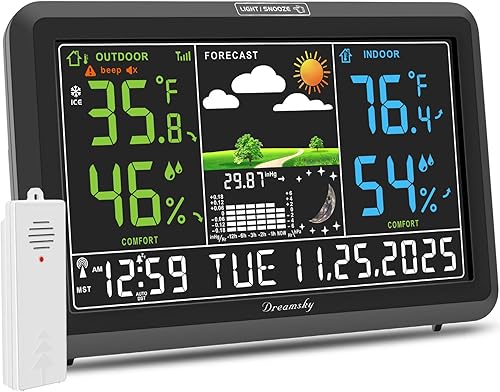
DreamSky Weather Station Indoor Outdoor Thermometer Wireless: Best for bedside use
- Large colorful display with 5-level backlight
- WWVB atomic clock with auto DST
- High/low temperature alerts
- USB charging port
A dimmable backlight and auto daylight saving time make this the pick for a nightstand or bedroom shelf.
Pros
- Five backlight levels
- Auto DST on the atomic clock
- USB port for charging
Cons
- Battery-only mode dims after 10 seconds
- Forecast relies on pressure trends
DreamSky's strength is night-time use. The backlight has five brightness levels, so you can dim the display for sleep and still read the temperature when you wake.
The screen is 7.9 inches wide and 4.9 inches high, which leaves room for big numbers without crowding a nightstand.
Its WWVB atomic clock adjusts for daylight saving time automatically, which saves the twice-yearly reset. The USB port on the back adds a handy charging spot beside the bed.
The unit runs on corded electric, with three AA batteries as backup when the power drops.
The colorful display uses big numbers for the forecast, indoor and outdoor temperature, time and date. Like the Newentor, it supports three sensors but ships with one.
The outdoor sensor is a compact 4.9 inches tall, so it hangs easily on a fence or post.
Plugged in, the screen stays lit. On battery backup it lights for 10 seconds and then dims.
Temperature alerts can flash or beep, though the beep suits a room you're awake in. The 12 to 24 hour forecast uses a 7-day pressure calibration for your area.
Choose it for a bedroom or home office where a dimmable screen and accurate timekeeping matter most. Skip it if you want wind speed or rain totals.
AcuRite 02077M: Best for small shelves
- Color LCD with auto dimmer
- Self-calibrating 12-hour forecast
- Trend arrows and moon phase
- Over 15 data points
A compact display with a self-calibrating forecast suits a kitchen counter or office desk where space is tight.
Pros
- Compact footprint
- Auto-dimming color display
- Self-calibrating forecast
Cons
- No wind or rain readings
- Needs an outlet for full brightness
AcuRite's 02077M is the small-space pick. At 4.5 inches wide and 6.6 inches high, its footprint is compact enough for a kitchen counter or desk, and the color display dims itself so it doesn't glare at night.
It weighs just over a pound and stands upright without a wall mount.
The self-calibrating forecast uses local pressure trends to predict the next 12 hours. AcuRite packs over 15 data points onto the screen, including trend arrows and the current moon phase.
Signal strength from the outdoor sensor also shows, so you can spot a weak link before it drops readings.
An included AC adapter keeps it bright, and optional batteries cover short outages. The sensor runs on two AA batteries and hangs from its built-in hanger on a post or branch.
It transmits on 433 MHz to the display.
This is a thermometer and humidity station at heart. It reports indoor and outdoor conditions, pressure and forecast, but not wind or rain.
The one-year limited warranty and US-based support add peace of mind. AcuRite has been building weather gear in Wisconsin since 1943.
Pick it for a first station or a small apartment, or for a desk where the screen needs to stay out of the way. It's also a safe gift for a new homeowner who wants simple numbers, not a dashboard.
Indoor Outdoor Thermometers Hygrometers Wireless Weather Stations: Best for humidity tracking
- Swiss-made Sensirion sensor
- Heat, dew point and mold indexes
- 330 ft wireless range
- Backlit 4.5 in display
Mold, dew point and heat indexes make this the station for basements, nurseries and rooms where damp air is a worry.
Pros
- Tight stated temperature and humidity accuracy
- Mold and dew point indexes
- Long 330 ft range
Cons
- Battery only
- Backlight runs for 10 seconds
Unni's station is built around humidity accuracy. A Swiss-made Sensirion sensor delivers stated accuracy of ±0.5°F and ±2% humidity, with an outdoor range down to -58°F for cold climates.
The indoor range starts at 14.2°F and tops out at 122°F.
The screen goes further than plain temperature and humidity: it shows a mold index, dew point and heat index for each sensor location. That makes it useful in a basement, laundry room or nursery, where damp air is the thing you actually want to watch.
The 4.5-inch display uses bold black numbers that read clearly from a few steps away.
Wireless data updates every 30 seconds from up to 330 ft away. The backlight runs 10 seconds when tapped, which is enough to read at night without lighting the room.
It supports up to three sensors on separate channels, each on its own channel setting.
The unit runs on batteries, so there's no cord to route and it can move from room to room. The one-year warranty covers the hardware but not batteries.
Its metal-black finish looks less plasticky than most stations here.
Choose it when damp air is the concern, such as a cellar or a room where mold grows. Skip it if you want a forecast, rain gauge or wind data.
It's the narrowest tool here, but it does its one job precisely.
Sainlogic 12-in-1 Wireless Station: Best for rain and wind
- Rain gauge with manual calibration
- Wind speed and direction
- Swiss temperature and humidity sensor
- 6.5 in screen with 3-level backlight
Solar power and a rain gauge turn this into a small backyard station for gardeners who want rainfall totals.
Pros
- Rain and wind readings
- Solar power with battery backup
- Large 6.5 in screen
Cons
- No WiFi or app
- Mounting pole not included
Sainlogic moves up from a thermometer station to a small backyard weather setup. Its outdoor array includes a rain gauge, wind speed and direction, plus Swiss temperature and humidity sensors.
The temperature sensor reads from -40°F to 140°F with about ±2°F accuracy, and humidity from 10% to 99%.
The 6.5-inch screen uses big bold fonts and a three-level backlight, so it reads well in daylight or a dim room. Rainfall accuracy is rated at ±1 mm in light rain and ±7% in heavy rain, with manual calibration for your location.
Barometric pressure spans 300 to 1100 hPa.
Solar power with battery backup keeps it running through long outages. Pressure, dew point and feels-like temperature round out the readings.
This model has no WiFi or app, so everything stays on the display. That keeps setup simple and means no account or router.
It's the pick for gardeners, farmers or anyone tracking storms. Plan a mounting pole, since the sensor array needs open sky and a clear run to the display.
The manual walks you through mounting on poles, rooftops or fences. Sainlogic offers US phone support on weekdays and email replies within a day.
Buy it if rainfall totals and wind direction matter to your day. Skip it if you only need indoor comfort readings.
FOKEY Weather Station Wireless Indoor Outdoor: Best for easy reading
- 7.6 in VA display
- Display on the remote sensor
- Atomic clock with 7 time zones
- Supports up to 3 sensors
Big numbers and a screen on the sensor itself help anyone who reads the display from across a room or checks the yard up close.
Pros
- Large high-contrast display
- Remote sensor has its own screen
- Self-draining sensor housing
Cons
- No WiFi or app
- Adapter needed for the full bright display
FOKEY puts readability first. The 7.6-inch VA display has high color contrast and big numbers, and the atomic clock covers seven US time zones from Hawaii to Atlantic.
That matters if you move the station or live outside the mainland's main zones.
The remote sensor carries its own 2-inch screen, so you can check conditions at the garage or patio without walking back to the main unit. Its housing drains itself in heavy rain and snow, which keeps the sensor alive through wet winters.
The main unit links to up to three sensors within 328 ft.
An AC adapter powers the full bright display, and the station syncs to WWVB daily for time and date. Set the time zone and daylight saving time before turning on the atomic sync.
FOKEY's team states a temperature error margin of just ±0.48°F.
The brand positions this as a no-app, plug-and-play unit, so there's no WiFi setup to fuss with. The adapter is the trade-off: without it, the screen won't hold its full brightness.
Its package is 8.62 by 7.24 inches, so measure your shelf first.
Pick it for older eyes or a large room, or when you want to read the yard sensor up close. Skip it if you need rain and wind data.
It's also a strong gift for a parent who likes knowing the morning temperature.
AcuRite Iris 01512: Best for full weather data
- Over 55 data points
- Wind speed and direction, rain, pressure
- Color LCD with dimmer
- Self-calibrating forecast
The deepest data set here, with wind, rain and historical readings for anyone who wants to follow a storm closely.
Pros
- Over 55 data points
- Rain and wind readings
- Large color display
Cons
- Runs on an outlet
- No smart-home connection
AcuRite's Iris 01512 packs the most data of any station here. Its five-in-one outdoor array reports wind speed and direction, rainfall, temperature and humidity, and the display adds over 55 data points including historical records.
Heat index, dew point and feels-like temperature are all on screen.
The color LCD has an adjustable dimmer and shows time and date. AcuRite's forecast takes elevation and pressure into account for a local 12-hour outlook.
The station runs on an outlet, so place it near a socket. The display is 8.13 inches wide by 6.75 inches high, one of the bigger units in this group.
Setup is simple: batteries in, sensor on a pole with the included bracket, and the display starts receiving. It's the deep-data pick for a weather hobbyist.
The pressure algorithm takes thousands of readings over time and sharpens its forecast as it learns your location.
The trade-off is the power cord and the lack of app or smart-home features. This is a standalone station for someone who likes watching trends on a dedicated screen.
The sensor's lower temperature rating is 32°F, so it's aimed at milder climates.
Choose it when you want wind and rain alongside indoor comfort, and you have a wall outlet near the display spot. Read our outdoor weather station guide for more on wind and rain sensors.
DreamSky Weather Station Indoor Outdoor Thermometer Wireless: Best for power outages
- Battery operated
- 7.2 in display
- High/low alerts with flash or beep
- Atomic clock with auto DST
Runs on batteries alone, so it keeps reporting temperature and humidity when the power goes out.
Pros
- Battery only
- Quiet alert mode
- Atomic clock with auto DST
Cons
- No color display
- No wind or rain readings
This DreamSky model is the battery-first option. It runs on three AAA batteries in the display and two AA in the sensor, so it keeps reporting when the power goes out.
There's no adapter and no cord, which makes it easy to move between rooms or take to a cabin.
The 7.2-inch screen shows indoor and outdoor temperature, humidity and pressure trends, plus a 12 to 24 hour forecast. High and low alerts can flash and beep, or flash silently for night use.
That quiet mode matters if the station sits near a bed or a nursery.
The atomic clock sets itself and adjusts for daylight saving time. The sensor updates every 30 seconds from up to 330 ft, and the station supports three sensors with one included.
The stated temperature accuracy is about 2°C, looser than the Swiss-sensor models here.
There's no color screen or adapter here. The monochrome LCD and battery-only design keep it simple and portable, which suits a cabin, garage or power-cut-prone area.
Its grey finish blends into a shelf better than a bright panel.
Buy it for outages or off-grid spots, or as a second station for a shed. Skip it if you want a bright color display or rain data.
The battery-first design is its whole point.
AcuRite Iris 01535M: Best for custom alerts
- Custom alerts for temperature, humidity, wind and rain
- Storm alarm on pressure drop
- Over 25 data points
- HD display
Threshold alarms and a storm warning suit someone who wants the station to tell them when conditions change.
Pros
- Custom condition alerts
- Storm alarm
- Clear HD display
Cons
- Lightning sensor sold separately
- Runs on an outlet
The Iris 01535M is the alert-focused Iris. Its five-in-one sensor covers wind, rain, temperature and humidity, and the HD display shows over 25 data points.
Weekly, monthly and all-time highs and lows are included, so you can compare this week to last.
What sets it apart is custom alerts for temperature, humidity, wind speed and rainfall, plus a storm alarm that sounds when pressure drops. That suits someone who wants the station to flag a change rather than wait to be checked.
You set the thresholds, so the alerts match your garden or workshop.
The display also works as an alarm clock, with time, date and day of the week. Like the other Iris, it runs on an outlet.
The HD panel measures 7.6 inches wide by 5.5 inches high, a good fit for a desk or shelf near a socket.
It costs more attention at setup than the thermometer stations, and the lightning sensor is sold separately. AcuRite's one-year limited warranty and US support apply.
The brand is based in Lake Geneva, Wisconsin.
Pick it when storms matter to your plans, such as a garden, boat or workshop. Skip it if you only want indoor and outdoor temperature on a simple screen.
Our backyard weather station guide covers sensor placement.
How these weather stations compare
| Product | Best for | Sensors | Power | Forecast | Our score |
|---|---|---|---|---|---|
| Newentor Weather Station Wireless Indoor Outdoor Thermometer | most homes | 1 included; supports 3 | DC adapter; battery backup | 12–24 hours, 7–10 day calibration | 9.6 |
| DreamSky Weather Station Indoor Outdoor Thermometer Wireless | bedside use | 1 included; supports 3 | Corded electric; battery backup | 12–24 hours | 9.5 |
| AcuRite 02077M | small shelves | 1 included | AC adapter; optional battery backup | 12 hours, self-calibrating | 9.3 |
| Indoor Outdoor Thermometers Hygrometers Wireless Weather Stations | humidity tracking | 1 included; supports 3 | Battery | 9.0 | |
| Sainlogic 12-in-1 Wireless Station | rain and wind | Outdoor array with rain gauge | Solar with battery backup | 8.6 | |
| FOKEY Weather Station Wireless Indoor Outdoor | easy reading | 1 included; supports 3 | AC adapter | 8.5 | |
| AcuRite Iris 01512 | full weather data | 5-in-1 outdoor array | Corded electric | 8.4 | |
| DreamSky Weather Station Indoor Outdoor Thermometer Wireless | power outages | 1 included; supports 3 | Battery | 8.2 | |
| AcuRite Iris 01535M | custom alerts | 5-in-1 outdoor array | Corded electric | 7.8 |
The split is clear: the top four picks are thermometer and humidity stations with atomic clocks, while the Sainlogic and both Iris models add wind and rain through an outdoor array. That second group needs more mounting space and, for the Iris models, an outlet near the display.
The Sainlogic gets around the cord with solar power and a battery backup.
Screen type matters more than it sounds. Color displays are easier to scan from across a room, but adapter-powered units dim quickly on battery.
Battery-first models keep a readable screen during an outage but skip the color. The FOKEY's VA panel sits in between: bright and contrasty, but dependent on its adapter.
Sensor count is the last divider. Every station here supports three sensors except the two AcuRite 02077M and Iris 01512, which ship with one and one array respectively.
Extra sensors cost extra, so count the rooms you actually want to watch. A station that watches three zones is only useful if you'll walk past the display to read all three.
Accuracy claims vary widely. The Unni and FOKEY quote tight figures from Swiss-made sensors, while the battery DreamSky states a looser 2°C margin.
For home use, the difference matters most in a greenhouse or wine cellar, where a degree or two changes the outcome.
How we compared these indoor outdoor wireless weather stations
We compared the specs and features of each station against what a home buyer checks first: display readability, timekeeping, sensor range, power options and the weather data each model reports. Our score weighs those specs and features against what you're shopping for.
We didn't run any station in a yard or measure its readings against a reference. The accuracy figures and ranges in this guide come from the makers, and we treated them as claims rather than verified results.
That's why the write-ups name the stated numbers instead of pretending to a lab result.
We also looked at what each model leaves out. A station without an anemometer can't report wind, and a battery-only unit won't stay bright all evening.
Naming those limits helps you match a station to the room and the yard. A cheap station that misses the feature you need is worse value than a pricier one that fits.
Scores sit between 7.8 and 9.6 so the gap between a basic thermometer station and a full backyard array stays visible. The top pick wins on daily usability, not on the number of readings it can show.
We favored units that are easy to read and set up over units that show the most data points.
Which weather station fits your home?
The best indoor outdoor wireless weather station depends on where the display goes and what you want to know. Answer the questions below before you buy.
Do you need wind and rain data?
If yes, choose a station with an outdoor array. The Sainlogic 12-in-1 and the two AcuRite Iris models report wind speed, wind direction and rainfall alongside temperature and humidity.
They cost more and need a mounting spot with open sky. The Sainlogic adds solar charging; the Iris models need an outlet.
If you only want to know how hot, cold or humid it is inside and outside, a thermometer station covers that at a lower cost. The Newentor Q3 and AcuRite 02077M are the simplest choices for that job.
The FOKEY and both DreamSky units also skip wind and rain.
Where will the display sit?
A kitchen or living room display should be bright and readable from a few steps away. The Newentor's color screen and the FOKEY's 7.6-inch panel both fit that spot.
The Newentor's 8-inch width suits a counter; the FOKEY needs a shelf at least 8.6 inches wide.
A bedside display needs a dimmer and quiet alerts. The DreamSky with five backlight levels is built for that, and its auto daylight saving time means you won't reset the clock twice a year.
The battery DreamSky's flash-and-mute alert is the quietest option here.
A garage or cabin with unreliable power calls for the battery-first DreamSky model. Check our best weather stations for your home roundup for more display-focused picks.
How far is the sensor from the display?
All these stations reach roughly 300 to 330 ft in open air, but walls and trees cut that range. Put the sensor where it has a clear line to the display and test the link before fixing it in place.
The Unni and FOKEY both quote 330 ft and 328 ft respectively.
Mount the outdoor sensor away from direct sun and heat sources. A shaded spot on a north wall gives a truer air temperature than a sunny post or a spot above a driveway.
Heat from a wall or roof will skew the reading by several degrees.
Do you want an atomic clock?
An atomic clock tunes to the WWVB signal and adjusts for daylight saving time on its own. The Newentor, both DreamSky models, the FOKEY and the AcuRite Iris 01512 all set themselves.
The Unni and AcuRite 02077M do not offer atomic time.
If you already have a wall clock you like, atomic time is a nice extra rather than a reason to choose one station over another. The bigger differences are the screen and the data each unit reports.
But for a bedside unit, the auto DST saves a real chore twice a year.
Should you add more sensors?
Three sensors let one display watch separate places, such as the yard, a greenhouse and a basement. The Newentor, DreamSky models, Unni and FOKEY all support three channels.
The Iris arrays already bundle their readings into one outdoor unit.
Buy extra sensors only for spots you'll actually check. A second sensor for a garage or a wine cellar makes sense; a third for a room you rarely enter usually doesn't.
Our smart weather station guide explains what app-connected models add on top.
How much does the power source matter?
Adapter-powered stations keep a bright screen all day but dim fast on battery. Battery-only stations stay readable in an outage but skip the color.
Solar models like the Sainlogic split the difference for outdoor gear.
Match the power to the room. A kitchen outlet is easy to reach, so an adapter model works there.
A garage or shed may only have batteries, which points to the battery-first DreamSky. For a backyard array, solar with battery backup means less wiring and fewer dead sensors.
The best indoor outdoor wireless weather station for most homes
The Newentor Q3 is the best indoor outdoor wireless weather station for most people, with a bright color display, self-setting atomic time and room for three sensors. It covers indoor comfort and backyard conditions without a cord getting in the way at night.
Choose the DreamSky with five backlight levels for a bedroom, the Sainlogic 12-in-1 for rain and wind, or the AcuRite 02077M for a small shelf. The Unni station is the pick when humidity and mold risk matter, and the FOKEY when big numbers matter most.
The battery DreamSky covers outages, and the Iris 01535M covers storm alerts.
Set the sensor in shade, test the link from the display spot, and count the rooms you want to watch before buying extra sensors. That checklist will keep the station useful long after the first week.
Our top 3 picks at a glance
-
1
Best for most homes
Newentor Weather Station Wireless Indoor Outdoor Thermometer
9.6/10 our score
See it on Amazon -
2
Best for bedside use
DreamSky Weather Station Indoor Outdoor Thermometer Wireless
9.5/10 our score
See it on Amazon -
3
Frequently asked questions
Do wireless weather stations need WiFi or an app?
No. The wireless part means the outdoor sensor sends readings to the indoor display by radio, so the station works without a router.
A smart weather station adds WiFi and app access, while these models keep everything on the display.
What is the difference between atomic time and a regular clock?
An atomic clock tunes itself to the WWVB radio signal and adjusts for daylight saving time. A regular clock needs setting by hand after a power cut or a time change.
How many outdoor sensors can one station handle?
Most displays here support three sensors on separate channels. One sensor comes in the box.
Extra sensors let you watch a garage, greenhouse or shed alongside the yard.
Can a station run on batteries all the time?
Yes on models built for it. Adapter-powered units dim their screens quickly on battery alone to save power.
A battery-first model keeps a readable display during an outage.
Do these stations measure wind and rain?
Only the models with an outdoor array that includes an anemometer and rain collector. Thermometer-only stations track temperature, humidity and pressure but skip wind and rainfall totals.