7 Best Weather Stations Without Wi-Fi (November 2026)
The best weather stations without Wi-Fi include the La Crosse Technology 308-1417 (best overall), the U UNNI Indoor Outdoor Thermometer Hygrometer (best compact indoor and outdoor pick), and the La Crosse Technology Advanced Weather Station (best color display).
On this page (8 sections)
- The best weather stations without Wi-Fi for different homes
- How these no wifi weather stations were compared
- What should a non wifi weather station measure?
- How does a no wifi station send data from the sensor?
- How are these stations powered?
- Where should you put a weather station without Wi-Fi?
- Do you need Wi-Fi for any of these features?
- Which no wifi weather station should you buy?
The best non wifi weather station for most homes is the La Crosse Technology 308-1417, a battery-only forecast station that shows barometric pressure with a 24-hour trend graph and sets its own clock. Pick the U UNNI for a compact indoor and outdoor thermometer, the Ambient Weather YG315 for an analog wall piece, or the Sainlogic 12-in-1 for rain and wind totals.
Wi-Fi is not the only way to get useful weather data. A non wifi weather station skips the router, the app and the account, and puts the readings on a screen you can read at a glance.
That matters in a garage with weak signal, at a cabin with no network, or in any home where the phone is not the point. The trade-off is honest: you give up remote access and cloud history, so the station only tells you what is happening where you can see the display.
For many buyers that is the whole appeal. Our backyard weather station guide covers placement and sensor siting if you are still deciding what you need.
Our picks at a glance
-
1

-
2
 Best compact indoor and outdoor pick
U UNNI Indoor Outdoor Thermometer Hygrometer
9.6/10 our score
See it on Amazon -
3

- 4
 Check it
Ambient Weather YG315 Traditional Weather Station
Best analog wall piece - 5
 Check it
Sainlogic 12-in-1 Wireless Station
Best for rain and wind data - 6
 Best for forecast learningCheck it
- 7
 Best for easy readingCheck it
The best weather stations without Wi-Fi for different homes
The La Crosse 308-1417 wins on the basics: pressure trend, indoor and outdoor temperature and humidity, and atomic time, all on batteries. The rest of the list fills in the jobs it does not do, from a three-dial wall piece to a full rain and wind set.
La Crosse Technology 308-1417: Best overall
- Battery operated
- Barometric pressure graph with 24-hour view
- 330 ft wireless sensor range
- Atomic self-set time
A battery-only forecast station with a pressure trend graph and atomic time. It suits a home that wants weather data without an app or a router.
Pros
- Pressure history graph
- Atomic time with automatic DST reset
- No router or app needed
Cons
- No wind or rain readings
- Batteries not included
The 308-1417 is the pick for a buyer who wants a forecast station and nothing more. Its barometric pressure graph shows the last 24 hours, so you can see whether pressure is climbing or falling and read the trend indicator next to the forecast icons.
Temperature and humidity come from a weather-resistant sensor with a 330 ft range in open air. Both readings keep daily MIN/MAX records and accept custom high and low alerts, which helps when a garage or greenhouse swings hard overnight.
Atomic time resets itself for daylight saving, and you can pick your US time zone. It runs on 5 AA batteries in total, so there is no outlet to find and no cable to hide.
The screen measures 6.88 in wide by 6.42 in tall, small enough for a shelf or wall bracket. The clear trade-off is coverage: there is no wind vane and no rain gauge, so it reports air and pressure only.
For a kitchen counter or a bedside table, that is the right trade.
U UNNI Indoor Outdoor Thermometer Hygrometer: Best compact indoor and outdoor pick
- Swiss-made Sensirion sensor
- 330 ft wireless range, updates every 30 seconds
- Heat index, dew point and mold index
- Supports up to 3 sensors
A small display that tracks temperature and humidity in several spots at once. Good for a garage, a greenhouse or a second room.
Pros
- Mold, heat and dew point indexes
- Accepts up to 3 sensors
- Backlit display button
Cons
- No wind, rain or pressure readings
- Backlight runs 10 seconds at a time
The U UNNI is the one to buy if you mainly care about temperature and humidity in more than one spot. It supports up to 3 sensors on separate channels, so you can watch a garage, a greenhouse and a spare room from one display.
The Swiss-made Sensirion sensor gives tight figures on paper: about ±0.5 F for temperature and ±2 percent for humidity. The display also shows heat index, dew point and mold index for each sensor location, which is more useful than a plain number when you are judging whether a basement is drying out.
It updates about every 30 seconds within 330 ft. The 4.5 in display has a backlit button that stays lit for 10 seconds, which is fine for a quick look at night and less handy as a constant night light.
It is also the smallest station here, so the readings are compact rather than large. Choose it for multi-room tracking, not for wind, rain or pressure.
La Crosse Technology Advanced Weather Station: Best color display
- Full-color LCD with forecast icons
- Atomic self-set time
- Adjustable backlight
- 330 ft sensor range
A full-color forecast display with adjustable brightness. Suits a kitchen counter or living room where a plain LCD looks dull.
Pros
- Color forecast icons with tendency
- Adjustable backlight settings
- Heat index and dew point views
Cons
- Needs a wall outlet for full features
- No rain gauge or anemometer
The Advanced Weather Station brings a full-color LCD and adjustable backlight to the no-router setup. The colors make the forecast icons and tendency arrows easier to read at a glance, and the backlight can run bright, low or off.
Atomic time and calendar are built in, along with MIN/MAX records and custom temperature alerts. It also shows heat index and dew point.
The sensor reaches 330 ft in clear air and is weather resistant. A 5V adapter powers the full feature set, and 3 AAA batteries keep it going as a backup.
That adapter is the main difference against the 308-1417, which runs on batteries alone. If your chosen spot has an outlet, the constant color display is nicer to live with.
If it does not, this station asks for a cable. It also stops at air and pressure, with no wind or rain data.
The color screen is the reason to pick it over the plainer pick above.
Ambient Weather YG315 Traditional Weather Station: Best analog wall piece
- Barometer, hygrometer and thermometer dials
- Solid wood base with cherry lacquer finish
- Hangs horizontal or vertical
- 2.5 in dials
A traditional cherry-finished wall station with three dials. It suits a study or office where the look matters as much as the readings.
Pros
- No batteries or power at all
- Barometer with a set needle for tracking change
- Hangs either way
Cons
- No wireless outdoor sensor
- Manual readings only
The YG315 is not a digital station, and that is the point. It is a solid wood piece with a cherry lacquer finish holding three 2.5 in dials: barometer, hygrometer and thermometer.
It hangs horizontally or vertically and needs no batteries, no adapter and no sensor. The barometer has a manually set needle you move to mark the current reading, so you can see how pressure has shifted since your last check.
Ambient Weather notes that pressure change over time is the useful signal, and that means reading it daily during unsettled spells. This is a piece for a study, office or library wall, not for someone who wants automated readings.
Because the dials read indoor air, it tells you about the room, not the yard. Pair it with an outdoor sensor station if you need both.
For the buyer who wants a weather instrument that looks good and asks nothing of the network, this is the one.
Sainlogic 12-in-1 Wireless Station: Best for rain and wind data
- Rain gauge with manual calibration
- Wind speed and direction
- 6.5 in screen with 3-level backlight
- Solar powered with battery backup
A full outdoor set with rain gauge and anemometer on one large screen. Pick it if rainfall and wind totals matter to you.
Pros
- Rain and wind readings
- Large 6.5 in display
- Solar assist with battery backup
Cons
- No Wi-Fi despite the full sensor set
- Needs pole mounting for the outdoor unit
The Sainlogic 12-in-1 is the pick when you want rain and wind without Wi-Fi. Its outdoor array carries a rain gauge, wind speed and direction sensor, and temperature and humidity readings, all feeding a 6.5 in display with large bold type and a three-level backlight.
Rainfall accuracy is about ±1 mm in light rain and ±7 percent in heavy rain, with manual calibration for local adjustments. The display tracks cumulative rainfall, dew point, feels-like temperature and pressure from 300 to 1100 hPa.
The unit runs on solar power with battery backup for round-the-clock operation. This is the most complete outdoor set here, and the largest screen.
The cost is setup: the outdoor array mounts on a pole, rooftop or fence, and you need a spot with a clear wind path. It is also not a connected station, so there is no app or online history despite the full sensor load.
Pick it for a garden or small farm where rainfall totals matter.
AcuRite Iris 01512: Best for forecast learning
- Over 55 data points
- Self-calibrating forecast
- Color LCD with dimmer
- Wind, rain and pressure readings
A color station that takes thousands of pressure readings to build a local forecast. Suits a backyard weather fan who wants more than a forecast icon.
Pros
- Barometer averages over time for a local forecast
- Color display with adjustable dimmer
- Historical data and trend arrows
Cons
- Needs mains power for the display
- Long calibration period before the forecast settles
The AcuRite Iris 01512 suits the buyer who wants the station to build its own local forecast. It takes pressure readings every 12 minutes and averages them over time, so the forecast becomes more tuned to your location the longer it runs.
AcuRite says that after about 14 days the calibration is reasonably settled. The color LCD shows more than 55 data points, including wind speed and direction, rainfall, heat index, dew point and pressure trend arrows, and a dimmer keeps it readable without glare.
The outdoor sensor includes an anemometer, rain gauge, wind vane, hygrometer and thermometer in one unit. The display runs on mains power, with 10 AA batteries across the system, so plan an outlet near its spot.
The long calibration is the honest trade-off: expect the forecast to feel generic at first. Choose it for backyard weather depth and a screen you will enjoy checking.
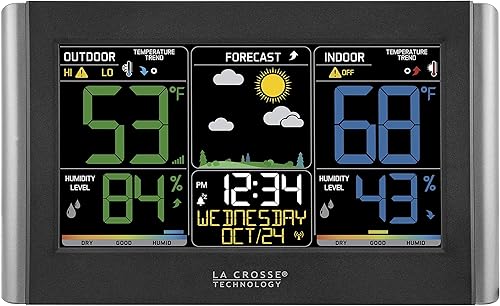
La Crosse C85845: Best for easy reading
- Color comfort bars for humidity
- Adjustable brightness
- Atomic clock with snooze alarm
- Wireless outdoor sensor
A color station with comfort bars that show when indoor or outdoor humidity drifts. Good for a kitchen where quick glances matter.
Pros
- Comfort color bars for humidity
- Atomic time with alarm
- Adjustable backlight
Cons
- No wind or rain sensors
- Barometric calibration takes a week or more
The La Crosse C85845 is the easiest station here to read at a glance, thanks to color comfort bars that show humidity levels indoors and out. A quick look tells you whether the air is dry, comfortable or damp without reading a number.
It has dynamic forecast icons with trend arrows, MIN/MAX records for temperature and humidity, custom alerts, and dew point and heat index views. Atomic time runs in 12 or 24 hour mode with an alarm and a 10 minute snooze, and the 5V cord keeps the backlight constant with 3 AA batteries as backup.
La Crosse asks for 7 to 10 days of barometric calibration before the forecast settles. The station reads temperature and humidity only, so wind and rain are out.
If your main question is "is this room too humid," the comfort bars answer it faster than any other screen here.
How these no wifi weather stations were compared
We compared each station on what it measures, how it is powered, how far its sensor reaches and what the display shows without a phone. Our score weighs specs, features and buyer feedback against what you're shopping for, and the highest score goes to the station that covers the most common needs with the fewest strings attached.
The La Crosse 308-1417 took the top score because it does the core job well on batteries alone. A station lost points for needing mains power if it added no wind or rain data, and a station gained points for rain, wind or pressure history.
The analog YG315 scored well for build and simplicity, with a mark against it for reading indoor air only. If you already own a connected model and it keeps dropping, our guide to a weather station not connecting to wifi walks through the fixes.
And if you want to see what a budget connected set looks like before you decide against Wi-Fi, the VEVOR weather station review is a useful comparison.
| Product | Best for | Power | Sensor range | Display | Our score |
|---|---|---|---|---|---|
| La Crosse Technology 308-1417 | overall | 5 AA batteries | 330 ft, no obstructions | LCD | 9.7 |
| U UNNI Indoor Outdoor Thermometer Hygrometer | compact indoor and outdoor pick | 3 AAA batteries | 330 ft | LCD with backlight button | 9.6 |
| La Crosse Technology Advanced Weather Station | color display | 5V adapter, 3 AAA backup | 330 ft, no obstructions | Color LCD | 9.4 |
| Ambient Weather YG315 Traditional Weather Station | analog wall piece | No power needed | Three analog dials | 9.1 | |
| Sainlogic 12-in-1 Wireless Station | rain and wind data | Solar plus 3 AA batteries | 6.5 in LCD | 8.6 | |
| AcuRite Iris 01512 | forecast learning | Corded electric; 10 AA batteries | Color LCD | 8.4 | |
| La Crosse C85845 | easy reading | 5V cord; 3 AA backup | Wireless RF | LED | 8.3 |
What should a non wifi weather station measure?
At minimum, a non wifi weather station should show indoor and outdoor temperature and humidity, plus barometric pressure with a trend. Those four readings are what let you judge comfort and coming weather without a network, and they are the base every pick here covers except the analog wall piece.
The extras sort the list. Wind speed and direction, rainfall totals and a pressure history graph are the features that separate a simple thermometer from a real station.
Decide which of those you will actually use before you pay for them.
Which readings matter for a home?
Temperature and humidity indoors tell you about comfort and mold risk. Outdoor temperature and humidity tell you about the yard.
Barometric pressure with a trend arrow is the one that hints at the next day's weather.
If that is all you want, a compact station like the U UNNI or the La Crosse 308-1417 is enough.
Do I need wind and rain sensors?
Only if you garden, farm or keep records. The Sainlogic 12-in-1 and the AcuRite Iris both report wind and rain.
Wind needs a clear mounting spot away from walls and trees, and rain needs a gauge that is not blocked by a roof edge.
If you will not use those numbers, skip the extra mounting work.
How does a no wifi station send data from the sensor?
A no wifi station sends sensor data by radio frequency to its own display. The outdoor unit broadcasts on a fixed channel and the display listens, so the two talk directly with no router, app or account in the middle.
That radio link is the whole system. Range is quoted at about 330 ft in open air for the models here.
Walls, metal siding, trees and a floor between sensor and display all cut that figure, so mount the sensor with a clear path in mind.
What is the real wireless range?
Treat 330 ft as a best case. A sensor across a yard with no obstructions should hold.
A sensor behind a brick wall or in a metal shed may drop out well before that.
The U UNNI updates about every 30 seconds, and the La Crosse units send by radio frequency as well.
Why does the station drop the sensor signal?
Distance and obstacles are the usual causes. Low batteries in the outdoor sensor are the next.
Move the display closer, replace the sensor batteries and press the sensor's transmit button to re-pair it.
A fresh start clears the old pairing.
How are these stations powered?
Most non wifi weather stations run on AA or AAA batteries in both the display and the outdoor sensor. Battery power is what makes these stations independent of both the router and the wall outlet, and it is the reason they suit a cabin or a shed.
A few models use a mains adapter for the display and keep batteries as backup. That gives a constant backlight and full features, at the cost of a cable and an outlet near the screen.
The analog YG315 needs no power at all.
Batteries only or mains power?
Choose batteries only if the display will sit somewhere without an outlet. The La Crosse 308-1417 runs on 5 AA batteries and asks for nothing else.
Choose mains power if you want a bright color screen all day and have a socket nearby; the Advanced Weather Station and the AcuRite Iris both want an adapter.
How long do the batteries last?
No run times are quoted for these models, so plan on fresh alkaline batteries at the start of each heating season and a spare set in a drawer. Cold weather drains outdoor batteries faster, so check the sensor first when readings go blank.
Where should you put a weather station without Wi-Fi?
Put the display where you will look at it daily and the sensor where it gets honest air. A shaded spot about 5 to 6 ft above grass gives the best temperature and humidity readings, and it keeps the sensor out of direct sun and off hot pavement.
Sun on the sensor pushes temperature readings high. A sensor over concrete or against a wall reads the surface, not the yard.
For rain and wind, the mounting rules get stricter, so read the backyard weather station guide before you drill anything.
Where does the outdoor sensor go?
Mount it in shade with air moving around it, away from the house wall and above the lawn. Keep it within radio range of the display.
A north-facing eave or a post under a tree works well.
Avoid a spot where sprinklers hit it or where snow will bury it.
Where should the display sit?
Put the display at eye level in a room you pass through, such as the kitchen or a hallway. Keep it out of direct sun so the screen stays readable.
If the station runs on batteries, a shelf or wall bracket is all you need; if it needs an adapter, pick a spot near an outlet.
Do you need Wi-Fi for any of these features?
No. Every station on this list works without a network, and none of them needs an app.
The only thing Wi-Fi adds on a connected station is remote access and online history, and neither is required to read current conditions or a local forecast.
The features that feel connected, such as self-calibrating forecasts and atomic time, run inside the station. The AcuRite Iris builds its forecast from its own pressure readings.
The La Crosse units set their clocks from the atomic time signal.
Neither touches your router.
What do you give up without Wi-Fi?
You give up checking the yard from your phone while you are away, and you give up cloud charts of past seasons. You also skip firmware updates and any smart-home tie-ins.
In exchange, there is nothing to reconnect when the router resets and no account to keep alive.
Can you add Wi-Fi later?
Not to these stations. If remote access matters later, a connected station is a separate buy.
Our roundup of the best weather stations for your home covers the connected options, so you can compare before you commit to a no-router setup.
Which no wifi weather station should you buy?
Buy the La Crosse Technology 308-1417 if you want the best non wifi weather station for everyday use: pressure trend, indoor and outdoor air, atomic time and battery power in one small screen. Pick the U UNNI for multi-room temperature and humidity, the Advanced Weather Station for a color display, or the Ambient Weather YG315 for an analog wall piece.
For rain and wind, go with the Sainlogic 12-in-1. For a station that builds its own forecast, the AcuRite Iris is the deeper choice, and the La Crosse C85845 is the easiest to read when humidity comfort is your main question.
If you are still weighing a connected model, read our weather station buying guide first.
Our top 3 picks at a glance
-
1
-
2
Best compact indoor and outdoor pick
U UNNI Indoor Outdoor Thermometer Hygrometer
9.6/10 our score
See it on Amazon -
3
Frequently asked questions
Do weather stations without Wi-Fi still need batteries?
Yes, most run on AA or AAA batteries in the display and in the outdoor sensor. A few use a mains adapter for the display and batteries as backup.
The analog YG315 needs no power at all, but it only reads indoor air.
How far can a no wifi weather station sensor reach?
The wireless models here reach about 330 ft with a clear line of sight. Walls, trees and metal siding cut that distance.
Place the sensor within reach of the display and test the signal before you mount it permanently.
Can I add a rain gauge or extra sensor to a non wifi station?
Only if the station supports extra channels. The U UNNI accepts up to 3 sensors on separate channels.
Stations with a fixed outdoor sensor, like the La Crosse 308-1417, take the one sensor that comes in the box.
Why choose a weather station without Wi-Fi over a connected one?
A non wifi station keeps working when the router drops, needs no cloud account and shows data without a phone. That suits a cabin, a garage or a home where you just want to glance at the screen.
Connected stations add remote access and history online.


